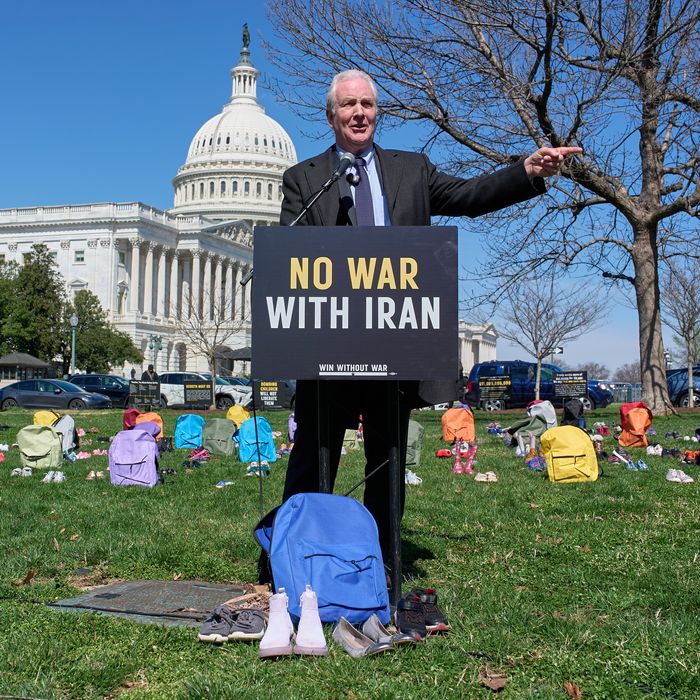
Sen. Chris Van Hollen, D-Md., speaks during an event and memorial display calling for an end of the war in Iran, Wednesday, March 18, 2026, on Capitol Hill in Washington.
Photo: Jacquelyn Martin/AP Photo
This spring, in the weeks after U.S. bombs hit Iran, Maryland Democratic senator Chris Van Hollen found his party's stance on the war “confused.†Senate Minority Leader Chuck Schumer demanded the Trump administration “be straight†about the objective of the attack. Hakeem Jeffries, Schumer's counterpart in the House, said Congress needed to hear a “compelling rationale†for the conflict. But looking through his colleagues' statements — trying to “suss out how they stand†— Van Hollen was frustrated. What really was the party's stance on the U.S. starting a war? Was it all just a problem of process? “The Democratic Party could have a much clearer voice, and clearer position, on questions of war and peace,†he told me. “We will obviously defend ourselves if we are attacked. But that's different than starting a war. There are some pretty basic principles that should guide us.â€
Instead of those clear principles, after the conflict began many Democrats focused on procedural missteps or pivoted to economic arguments, like higher gas prices. A few even hoped to find an upside to bombs, noting the ousting of an oppressive Iranian regime — which especially angered Van Hollen, who has long argued that only truly defensive actions make moral sense in war. “There is no win here,†he told me. The statements came off like evasion and only further entrenched an idea many voters already believe, he said: When it comes to talking about foreign intervention, the Democrat Party is “unclear†and “inconsistent.â€
As the myth of “Donald the Dove†falls apart in Iran — and Tucker Carlson implies the president is the “Anti-Christ†— it should be an opportunity for Democrats to capture some of the anti-interventionist vote. Sixty-four percent of Americans disapprove of the decision to go to war with Iran. The war has forced an ongoing crack-up in the Republican Party. And there is not strong internal opposition among the base to speaking out. Ninety percent of Democrat-leaning voters oppose Trump's handling of the war. Yet while the world “suggests a policy and political imperative for Democrats to be the antiwar party,†as Ben Rhodes, one of President Barack Obama's deputy national security advisers, recently wrote in the New York Times, “such a movement has not fully materialized.â€
Instead, the party is in a “messy†antiwar realignment, said Tré Easton, a longtime Democratic Hill staffer now working for a think tank. Democrats snapped into a clearer opposition to the Iran war, after Trump seemed to threaten nuclear annihilation, with some initially calling for his ouster through the 25th Amendment. But they are still trying to figure out exactly what the party stands for on foreign policy beyond opposition to Trump. In fact, it wasn't so long ago Democrats were attacking the president for the opposite: being too timid on Iran. (The 2024 Democratic Party platform critiques the president's “fecklessness and weakness in the face of Iranian aggression.â€) “This is the first time, basically in 25 years, where Democrats are being forced to actually have a proactive vision†on foreign policy, Easton said.
After 9/11, Democrats tried to match the sentiments of the country. The party largely endorsed the Iraq War and broader conflicts even as some members quietly harbored misgivings. This became Democrats' de facto stance: inching toward peace, triangulating to not look “weak,†and — eventually under President Obama — waging wars but not “dumb†ones. Defenders argued that Democrats were rationally confronting a world that was complex and dangerous. Detractors saw hypocrisy: Democrats argued that the war in Iraq was a mistake but that the war in Afghanistan wasn't; that the prison at Guantánamo Bay was unconstitutional but that extrajudicial drone killings were not. “Smart†war ended up including a good deal of intervention. Obama undertook a regime-change operation in Libya on the pretense of protecting civilians, abetted war crimes by partnering with Saudi Arabia in Yemen, and approved a CIA operation during a civil war in Syria (which was also as part of a regime-change strategy).
In many ways, this was par for the course. The Democratic Party has long had a sizable group of peaceniks while broadly supporting candidates who approve of conflict under certain circumstances. Since Vietnam this tension on foreign intervention has caused regular flare-ups. Usually, Democratic presidents address the dissonance by mixing war and peace — engaging in intervention, talking up diplomacy, doing some of both. But that compromise has risks. Obama advanced new diplomatic deals with Iran and Cuba, delivered humanitarian aid to Haiti, and even executed a major troop withdrawal in Iraq; these moves are less often mentioned in his legacy than drones. Obama “got the country out of ‘war,' at least as we used to see it,†Jon Alterman, from the Center for Strategic and International Studies, said in 2017, but also left the country “wrapped up in all these different conflicts, at a low level and with no end in sight.â€
To explain the nuance of their party's stance — against certain wars but not others; never against “the troops†— Democrats have become known for careful, calibrated language on conflict. This stance can be muddled and easy to mock. When I spoke to Morris Katz, a political strategist for Senate candidate Graham Platner, he mimicked how the Democrats have sounded talking about war via crude metaphor: “Hey, the Republican Party is fucking you, we're just going to make sure that they're fucking you in the proper way, following all the protocols.â€
Platner — whose primary opponent, Janet Mills, recently dropped out amid punishing poll numbers — is representative of an insurgency pushing for an anti-interventionist Democratic Party. His candidacy is rooted in talking about the betrayal of forever wars in the Middle East. And he hopes to win back some of the veterans and disaffected peace voters Trump won with hefty margins in all three of his presidential campaigns.
When I asked Platner what he made of Democrats' current opposition to the Iran war, he wasn't convinced. “It is hard to take seriously people's gnashing of teeth around this war, when a lot of these folks have been very supportive of U.S. military adventurism†in the past, he said. Platner's opposition to Iran is rooted in a basic moral argument: that the war is horrific and unnecessary. “If you have legitimately changed your mind, then you shouldn't be opposed to this stuff on, like, process grounds,†he told me. “You should be opposed to it on moral grounds. And you need to be full throated about it.â€
Adam Hamawy is another candidate like Platner. He served as a medical responder in New York on 9/11, an Army combat surgeon in Iraq, and recently as a health-aid volunteer in Gaza. As an insurgent Democrat running for New Jersey's 12th Congressional District, he can't talk about foreign policy in vague terms; he thinks of bullet wounds and pints of blood.
When, in early April, I asked Hamawy about the war in Iran, he was blunt: “On day one, we bombed a school filled with over 100 girls and they were killed.†It reminded him of Gaza, where he saw children whose “bodies were blown apart by the weapons we make.†Hamawy is out of step with the Establishment, too radical, it seems, for how he talks about war. (A rare exception is U.S. senator Tammy Duckworth, who credits Hamawy with saving her life in 2004 after her Black Hawk helicopter was shot down in Iraq. Her endorsement hails Hamawy's “willingness to call out injustices at home and abroad.â€)
Hamawy experienced a chilly reception when he ventured to Capitol Hill to talk about his time in Gaza. Among the few Democrats who agreed to meetings was Cory Booker, his home-state senator. “I told him about my experiences, and he said, ‘You are a hero for what you did,'†he recalled. Hamawy then urged Booker to oppose funding for the war — to “stop what's happening.â€
“He didn't have a response to that,†Hamaway said. “And that's what's wrong with our party.†(In an email, a Booker spokesperson said that he “has deep respect for Dr. Hamawy†and has “consistently engaged in efforts to secure a ceasefire.â€)
Moderates find this kind of argument impractical bluster. “The American people decide, through Congress, whether the war is legal or illegal,†former Kentucky Senate hopeful Amy McGrath, who flew fighter jets in Iraq and Afghanistan, told me in April. “Not the president, not Graham Platner — the American people.†McGrath believes that the congressional process is still the fundamental issue. And processes are the vital core of democratic government. (She lost her Democratic primary to Charles Booker, who has criticized the Iran war, writing that the U.S. should not fund “bombs for warmongers.â€)
Representative Seth Moulton, a Marine veteran of Iraq now running for Senate, also told me specificity matters. He is firmly anti-intervention with regard to Iran but has supported the U.S.'s funding of Ukraine's fight against Russia. For him, procedure is a core issue — it is how you negotiate when to use force. He lamented that “at least Congress had voted on [Iraq]. At least the American people had weighed in. At least the generals had come before Congress and put forward a plan. None of that exists today.†Moulton believes lawmakers would “ask much tougher questions†if Congress ever reasserts its powers to authorize force in Iran.
Despite disliking the party's response, Van Hollen agreed votes on the Iran war would force Democrats to act. He said a rhetorical reckoning will “come to a head when the money request comes forward†for the Iran war later this year. And he noted that direct American involvement in the Vietnam War ended in 1973 only because Congress finally decided to stop funding it. “The money piece of this is so important,†Van Hollen said. “That is the best check.â€
There are indications that the party is shifting its positions on those votes. Representative Jason Crow, a former Army Ranger tasked with recruiting candidates ahead of the midterms, admitted to me the Iran war has made him look at withholding military funding. Crow, who has usually voted in support of the Defense budget since being elected in 2018, told me that, in light of various military abuses and the White House's staggering $1.5 trillion budget request, he expects this year to vote no. “I think we have crossed the rubicon,†he said.
But Katz and others told me these procedural moves are unlikely to change Democrats' reputation. Representative Ro Khanna believes only a purge of military interventionists would work to win back voters frustrated with the party's foreign policy. In 2004, Khanna launched one of the first (and unsuccessful) anti–Iraq War primary challenges against a federal lawmaker. He does not see it as possible to convince voters of a real change with the party's hawkish older guard — beginning with Senate Minority Leader Schumer — in power. “I don't know how someone who supported the war in Iraq is still leading this party,†he said.
The closest thing modern Democrats have come to having a fiercely anti-interventionist party leader was Howard Dean. In June 2003, the then-governor of sleepy Vermont mounted an upstart campaign for president focused on calling out equivocation. “They all wobble around a little bit,†Dean told the New York Times in 2003 of his opponents' stances on the Iraq War. â€I think John Kerry still is ambiguous, and I still don't know what he stands for to this day.â€Â A few months later, Dean was No. 1 in many national and state polls.
“Everybody else was backpedaling and playing both sides of the issue,†Dean told me of Democrats at the time when I recently reached him by phone. The party was “scared†and “mealymouthed†on the war, he said — against the invasion but not too much.
A prototypical example was Kerry, the party's 2004 standard-bearer. In 2002, he voted to authorize force in Iraq; in 2003, he voted against funding it, then supported funding it, and then, when it was certain the bill would fail, said he did not support the legislation. To clear things up, Kerry said: “I actually did vote for the $87 billion before I voted against it.†After it became indisputable that Saddam Hussein did not possess weapons of mass destruction, Kerry said he stood by his Iraq vote — just over a month later he told ABC the opposite, that “we should not have gone to war knowing the information that we know today.â€
Dean's run ultimately failed. But he is firm that it was not because he was boldly antiwar. “We got to where we got,†he told me, “because I spoke my mind.†Since his failed outside presidential run, Dean has become a pillar of the party, first through a stint as DNC chair, then as a Biden surrogate. I was curious if the latest conflict had made him even more fiercely antiwar and distressed about the Democrat Party's lack of progress since his campaign on foreign policy. He said he did not support the Iran conflict but expressed an openness to hearing arguments for intervention generally. “I don't reflexively look at war and say it's all bad,†Dean told me.