
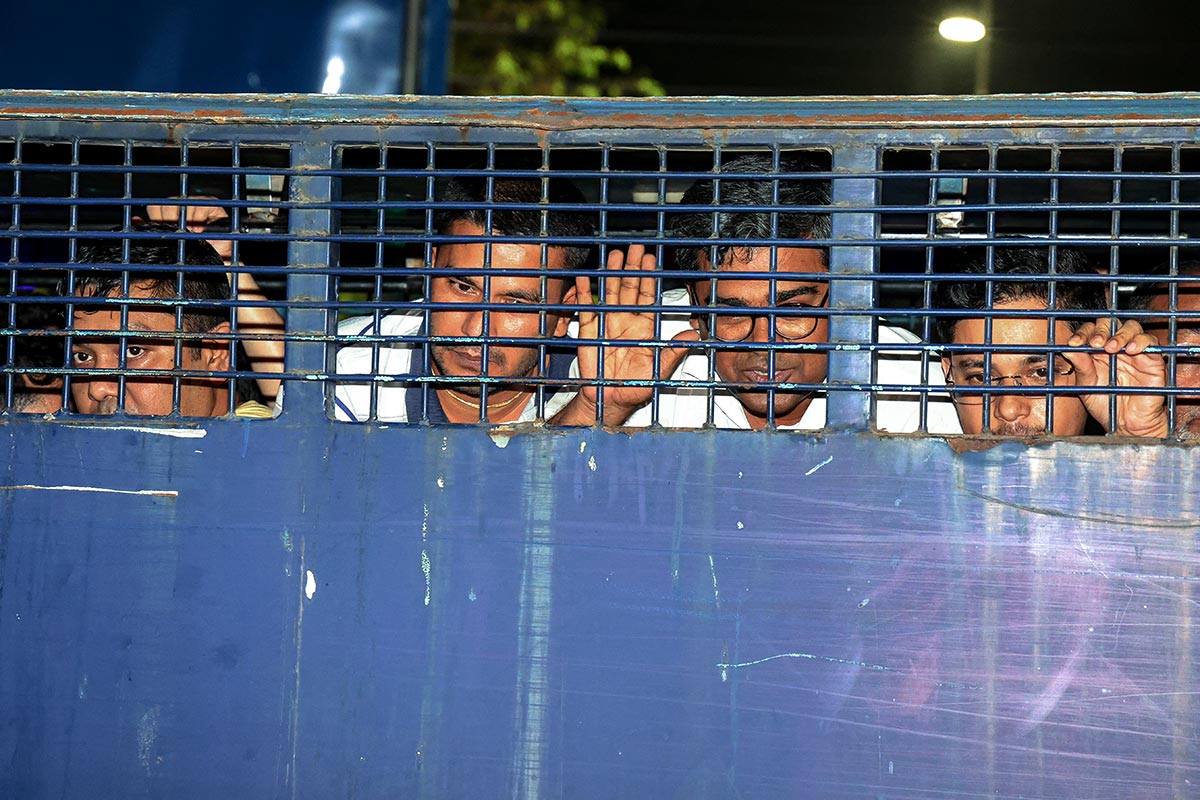
On 14 May, Farzana Rupa, a prominent presenter at Ekkator TV – a channel widely regarded as partisan to the Awami League during its time in government (2009-2024) – was produced before Bangladesh's International Crimes Tribunal (ICT) along with the station’s managing director and founder, Mozammel Babu, where the judges remanded them both back into custody. Earlier the prosecution had told the Tribunal that the investigation officer had found them complicit in the offence of “crimes against humanity†as well as in forced disappearances.
Both journalists have already spent over 21 months in pre-charge detention without bail on separate murder charges relating to their alleged roles in the hundreds of law enforcement killings that took place during the student protests which culminated in the fall of the Awami League government in August 2024. Till now, no evidence has been presented by prosecutors to show their criminal involvement in these murder cases, and their detention for these offences has already been widely criticised by human rights organisations.
The new arrests relate to events eleven years earlier, on 5 May 2013, during the first of the Awami League’s three consecutive terms in government, when security forces moved to disperse thousands of Hefazat-e-Islam supporters – an ultra-conservative Islamist organisation – who had gathered in their tens of thousands for a rally at Shapla Chattar in central Dhaka. The group had assembled to demand the “trial of atheist bloggers†and enactment of a new blasphemy law.
At the time, the media reported that at least 21 people were shot dead in Dhaka and on the outskirts of the capital city, though the true toll was heavily contested. The government admitted to 11 deaths, while a report by Human Rights Watch documented at least 58 deaths including 8 members of the security forces. The Awami League government subsequently prosecuted two leaders of the Bangladeshi human rights organisation Odhikar – which had published a report citing 61 deaths – on charges of “prejudicing the image of the stateâ€. The government did not set up any investigations into the killings themselves and no members of the security forces was held to account.
“Is this journalism?â€
Prosecutors from the ICT have not yet furnished the lawyers representing Babu and Rupa with the legal grounds for their arrests. At a press conference on 7 May, however, the tribunal’s chief prosecutor, Aminul Islam – appointed by the newly elected Bangladesh Nationalist Party –  sought to justify the detentions publicly.
“They broadcast distorted news. They concealed the homicides. They spread propaganda to the people. Is this journalism?†he said.
Islam pointed to a documentary called “Shamikaran†[Equation] , broadcast by Ekkator TV in 2014 and presented by Farzana Rupa, which he claimed “distorted the language, the facts, and the information to such an extent she was claiming that not a single person was killed or injured. You tell me, was that a correct statement? Yet, we have identified 32 people [killed] at that spot.†He then went on to suggest that it was “clearly evident†from this report that “she was involved in the plan of what was to happen at Shapla Chattar. That she was part of the total mechanism beforehand. That is the crime.â€
FIND THIS ARTICLE INTERESTING?
On the question of Babu's arrest, the chief prosecutor said: “He was present there all night long,” and that whilst other TV stations had been prevented from broadcasting that night, “his live programme continued. And he was concealing the killings. What was his interest? He is a journalist; he should have presented the true facts neutrally before the nation… If he didn’t, then what was his purpose? Why did he do that? This means he was involved with the total mechanism.”
The chief prosecutor did not explain how a documentary about the violence of 5 May 2013, broadcast the following year, could constitute evidence of the presenter’s prior involvement in planning the killings that took place that day. He also did not point to any specific broadcast made by the station that night which could implicate Babu in criminal conduct.
Hamidul Misbah, the lawyer acting for Babu, said he thought the prosecution was “unprecedentedâ€, raising “serious questions regarding the boundaries between lawful journalistic activity and criminal liability.â€
“Journalists are often required to report on controversial events, scrutinise matters of public importance, and present information that may not be viewed favourably by particular sections of the society. However, the fact that journalistic work may be controversial or unpopular cannot justify its treatment as conduct amounting to crimes against humanity,†Misbah said.
Monphool Chandrabawti, the daughter of Rupa, now 19 years of age, said that she was “heartbroken†seeing her mother “facing allegations of crimes against humanityâ€. “Her reporting occurred a year after the events had already taken place, and numerous other journalists reported on the same events,†she added.
“Weaponizing†the ICT
International human rights organisations have also strongly condemned the arrests of the two journalists. “Editorial decisions on covering a contested political incident are not crimes against humanity, and using an international criminal law framework to punish journalists circumvents the basic protections guaranteed to the press under Bangladesh's own constitution while also violating international human rights conventions,†said KunÄl Majumder, the Asia-Pacific Program Coordinator of the Campaign for Press Freedom. “Bangladeshi authorities must stop weaponizing the International Crimes Tribunal to target journalists and immediately release Farzana Rupa and Mozammel Babu.â€
Smriti Singh, South Asia Regional Director of Amnesty International added to the criticism: “Farzana Rupa and Mozammel Haque [Babu], who are already in detention, now face vague new charges relating to a story that was aired more than a decade ago. Their arrest in a case related to crimes against humanity is an affront to fundamental principles of press freedom and sets a dangerous precedent that threatens the right of all journalists to report without fear of retaliation.â€
Journalists have very rarely been the subject of a prosecution for crimes against humanity or other international crimes. One of the few successful cases arose from the Rwandan genocide, in which some of the owners and journalists of Radio-Télévision Libre des Mille Collines, as well as the chief editor of the newspaper Kangura were convicted for their roles in inciting the mass killing of Tutsis during the hundred days between April and July 1994. In the case against them before the UN International Criminal Tribunal for Rwanda (ICTR), members of the radio station were convicted on the basis of broadcasts in which reporters repeatedly called for the “extermination” of the “cockroaches” – the term used to dehumanise and designate the Tutsi population as targets of violence. One of the articles published by Kangura, which resulted in the conviction of the newspaper's chief editor stated that, “Let's hope the Inyenzi [cockroaches] will have the courage to understand what is going to happen and realize that if they make a small mistake, they will be exterminated; if they make the mistake of attacking again, there will be none of them left in Rwanda, not even a single accompliceâ€.
The ICT has not yet made any claim that Ekkator TV, Babu or Rupa has stated anything that meets the kind of evidence that would meet the standard of “direct and public incitement†to commit an international crime that the ICTR required in its media trials.
The two journalists, who are due to be questioned by the ICT investigators, are not the only people accused in this case. In March 2025, the Tribunal issued arrest warrants for the former prime minister Sheikh Hasina, the then Dhaka Metropolitan Police Commissioner Benazir Ahmed, seven other politicians and members of the security forces. Most of the nine accused now live outside Bangladesh. In November, the ICT also issued a similar warrant for the arrest of Shahriar Kabir, a well-known campaigner against Islamic fundamentalism who had advocated for the prosecution of those who collaborated with the Pakistan military during Bangladesh's 1971 War of Independence.
Recommended reading
Justice vs justice