
In hindsight, from the moment Israel partially lost the US's backing over the invasion of Rafah in May 2024, it became inevitable that the International Criminal Court would go after some Israeli officials regarding the conduct of the Israel-Hamas War.
The ICC's Office of the Prosecutor (OTP) had been threatening to do so since only a few weeks into the war as soon as Israel started its large counterstrike bombing campaign and invasion of northern Gaza.
But it was not inevitable that the OTP would go after Israelis such as Finance Minister Bezalel Smotrich over the settlement enterprise.
All prior war-crimes tribunals have been for genocide, crimes against humanity, and general mass intentional killing. They have not prosecuted people or officials for building houses, let alone in disputed territories – meaning where the houses being built could turn out to be fully recognized even by the UN as legal if the Israeli-Palestinian conflict ended with an agreed-upon split of the West Bank.

Smotrich has made many highly problematic statements that could be construed as incitement against Palestinians. But he has no direct power over the IDF the way Prime Minister Benjamin Netanyahu, or former defense minister Yoav Gallant – the ICC issued arrest warrants for both of them in 2024 – or IDF high-ranking officers have had.
There is no real viable case under the ICC's own Rome Statute against Smotrich for the IDF's conduct in the Israel-Hamas War.
On the other hand, Smotrich can be held accountable for Israeli settlement policy in the West Bank.
As a minister in the Defense Ministry responsible for settlement policy, he has directly and indirectly established a staggering number of new settlements and outposts in the West Bank. Some of them have been totally legitimate, but some of them have led to controversial evictions of Palestinian residents.
Usually the process does not involve the IDF bulldozing Palestinian residential structures, although that does take place in two main situations.
It happens occasionally in areas where the military says Palestinians had built new structures without permits.
The policy is also used to counter a wave of terrorism originating from a specific area. That takes place when IDF Central Command determines it cannot secure that area without removing some structures occupying the adjacent high ground. (A subset of this is demolitions of terrorist houses, but that is usually only one at a time and not a neighborhood.)
Both of these cases can be considered problematic.
When the IDF in recent years issued new building permits for Jews in Judea and Samaria and did not for Palestinians, how can Smotrich complain when Palestinians lose patience and build illegally on barren unoccupied land?
While there could be some logic to temporarily commandeering certain residential structures to put down a temporary terrorist wave, can Smotrich and some IDF senior officers truly justify utterly destroying a neighborhood or a large swath of Palestinian trees and greenery as being proportional against such a temporary terrorist wave?
But problematic as some of these actions may be, they have either legal or security logic to them, making it very difficult to criminalize them.
ICC likely to persecute Smotrich over settler violence
Rather, the ICC's latest case against Smotrich is likely about the unofficial space he has created in allowing several hundred or more anarchists – the name the IDF has given them – to intimidate and burn Palestinians villages and agriculture in certain areas to make it easier for certain extremist Jews to seize those areas by force, i.e., also unofficially.
Typically, there will be a weak and somewhat isolated Palestinian village or agricultural area that some Jewish extremists will target by deliberately building a new “farm†nearby with no authorization from the IDF.
Over time, the Jewish farmer or some associates will engage in a series of attacks on the nearby Palestinians.
UNDER THE influence of Smotrich and, of course, National Security Minister Itamar Ben-Gvir, Israeli authorities have either avoided or been unable to stop many of these activities, although there are occasions when they succeed at stopping them and arrest some Jewish extremists.
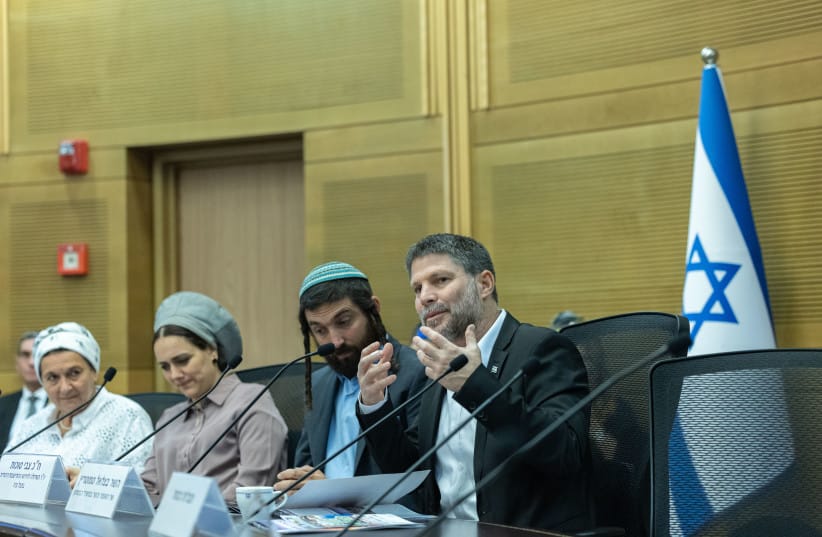
This is one area of ICC focus where Israel could have a real problem.
ICC aiming at Israeli settlement enterprise
But again, this is not the main issue. The main issue is that the mix of these worsening trends may have finally made the ICC feel that the entire settlement enterprise is within its reach after nearly 25 years in which it left such battles to purely theoretical advisory opinions of the International Court of Justice (ICJ.)
The ICJ has ruled against Israel's settlement enterprise multiple times, but without any teeth or mechanism for enforcement, since the US has blocked any real concrete movement on the issue at the UN Security Council.
But the ICC is not bound by the UN Security Council and has enforcement powers.
In other words, seeking an arrest warrant against Smotrich could be the beginning of a Pandora's box in which Jews living in the settlements eventually come under the same scrutiny for traveling the world and doing global business that some IDF officers have come under.
In the past, The Jerusalem Post has interviewed NGO officials who also talked about criminalizing Israelis living within the Green Line who provided utilities and other services to West Bank settlements.
Around 125 countries, including most of the West, are members of the ICC.
Smotrich could be the ICC poster boy for criminalizing the entire Israeli-Palestinian conflict, which would also put Jerusalem at a distinct disadvantage in any future talks about setting borders, however distant such talks might seem at this moment.
What should Israel be doing about it?
First, the legal, diplomatic, and public-relations battles regarding the IDF and the settlement enterprise can be separate and distinct.
Israel should do all it can to defeat legal charges against its conduct in Gaza by filing jurisdictional appeals, by publicizing the results of its own thousands of probes into its soldiers, and by pressing the ICC diplomatically to find an exit from a battle where it will achieve little.
Nevertheless, the fight over the settlement enterprise will be different.
On the one hand, Israel has an advantage in that such issues have never been prosecuted as war crimes. In addition, there are other similar cases, such as with Turkey in Northern Cyprus that the ICC has avoided prosecuting. That means Israel can claim arbitrary discrimination.
On the other hand, the solution to the settlement enterprise's problems is as much political and diplomatic as anything else.
When Israel was viewed by the world as not trying to change the status quo and being open to peace initiatives, the West did not support the ICC getting involved in the settlement issue, and the ICC stayed out of it.
Trying to bring an ICC case against Smotrich relating to the settlements may be a major stretch in legal terms, but he has created such a problematic global brand that it is more popular internationally than going after IDF soldiers.
Removing him from authority in this area in whatever future government takes over – there are many strong cabinet ministers without West Bank authorities – would be a start.
Returning to peace talks of any kind, however unrealistic and however distant any concessions might be, could also improve Israel's standing on the issue.
Finally, there is no question that Israel getting a handle on the lawlessness of extremist Jews in the West Bank is of primary importance, not just for blocking ICC intervention but for Jerusalem to uphold its own rule of law.
Without major changes in Israeli policy in this area, the arrest warrant against Smotrich could be Israel's darkest legal hour, with cascading consequences the likes of which cannot be fully foreseen.