
Chimpanzees do not go to school or learn from books. Instead, young chimpanzees spend years watching older members of their group to learn how to survive in the forest.
A new study from Uganda shows that this learning process is much more complex than scientists once thought.

Researchers from the Max Planck Institute of Animal Behavior, the Budongo Conservation Field Station, and the University of St. Andrews studied wild eastern chimpanzees in Budongo Forest for more than two and a half years.
The team found that chimpanzee culture goes far beyond famous behaviors like tool use.
Everyday activities such as eating, grooming, and social interactions may also be passed from one generation to the next.
For years, scientists identified chimpanzee culture by comparing different groups.
If one community used stone tools to crack nuts while another did not, researchers considered the behavior cultural if environmental or genetic differences could not explain it.
This method helped establish the idea that animals can have culture. However, it mainly captured dramatic and obvious behaviors. Many shared daily practices may have escaped notice because they appeared ordinary.
“Excluding genetic and environmental causes of behavioral variation was an important first methodological step to demonstrate social transmission and as such the existence of animal culture,†said Nora Slania of the Max Planck Institute of Animal Behavior.
Watching the watchers
To uncover these hidden layers of culture, researchers focused on a behavior known as peering.
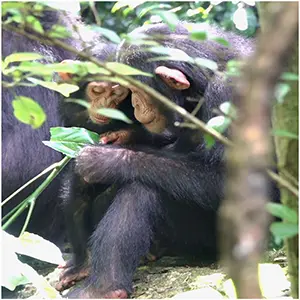
Peering occurs when one chimpanzee watches another closely for several seconds, usually at close range and with intense attention.
Scientists suspected this behavior might reveal what chimpanzees consider worth learning.
If peering reflected learning, the researchers expected young chimpanzees to peer more than adults and to focus on experienced individuals. The study confirmed both predictions.
Thousands of observations
The team followed 28 chimpanzees from the Sonso community over roughly 1,100 hours of observation. The group included 17 immature chimpanzees and 11 adults.
Observers recorded behaviors every three minutes and logged every peering event they saw. In total, the researchers documented 358 peering events.
The data revealed that peering peaked around age five before declining steadily into adulthood.
Young chimpanzees carried out most of the close observation, supporting the idea that peering helps individuals acquire important skills during development.
Rare foods attract attention
The type of food being eaten strongly influenced peering behavior.
Chimpanzees paid more attention to foods that required several processing steps before consumption. Rare foods also attracted greater interest than common items.
This pattern suggests that young chimpanzees rely heavily on social learning when dealing with difficult or infrequent tasks.
“Animal culture doesn't have to be rare or complex. It can include basic skills used every day, like finding food and knowing how to eat it,†said Slania.
Chimpanzees with experience
Young chimpanzees strongly preferred watching older individuals.
Experienced adults likely possess valuable knowledge gained over many years in the forest.
Researchers also noticed a smaller peak in attention directed toward similarly aged peers, suggesting juveniles learn from one another as well.
Younger and less experienced chimpanzees attracted very little attention.
A wide social network
Scientists have long viewed mothers as the primary source of cultural learning for young apes. The new findings present a more complex picture.
Very young infants did peer mostly at their mothers. However, once researchers adjusted for how often mothers were simply nearby, another pattern emerged.
Young chimpanzees also showed strong interest in unrelated adults from an early age. By about three years old, unrelated group members became preferred targets when available.
The results suggest that chimpanzee culture spreads through a wider social network than researchers previously thought.
Everyday life matters
Perhaps the study's most surprising finding involved the number of behaviors associated with peering.
Researchers identified 166 distinct behaviors within the Sonso community. Of these, 69 behaviors attracted peering attention at least once.
That figure nearly doubles previous catalogs of chimpanzee cultural behaviors collected across multiple study sites.
Most of the peering did not involve tool use. Around 53 percent focused on non-tool feeding behaviors. Another 26 percent involved grooming activities.
The findings suggest that daily activities may hold far more cultural significance than previously recognized.
Grooming traditions emerge
Grooming may seem instinctive, but earlier studies have shown that chimpanzee groups can groom differently.
The new study found that young chimpanzees spent considerable time observing grooming behaviors. This supports the idea that specific grooming styles may spread socially through observation.
“The fact that so much of a chimpanzee's diet is socially learned highlights how important social learning is for their development,†said Dr. Caroline Schuppli, senior author of the study.
“While some behaviors may be simple and learned quickly, acquiring the full range of their culture still takes young chimpanzees many years.â€
Animals with rich cultures
The study carries implications far beyond chimpanzees.
If scientists have underestimated culture in one of humanity's closest relatives, the same may hold true for dolphins, monkeys, birds, and many other animals.
“In humans, our everyday lives are full of culture, including the way we speak, dress, or eat. We don't require behaviors to be especially remarkable or independent of our environment,†said Schuppli.
“Animals, however, have long been held to stricter standards. By adopting a more inclusive view of culture, and standards more comparable to those applied to humans, future research may reveal that many animals possess richer cultures than previously recognized.â€
For decades, scientists searched for culture only in spectacular acts.
This study suggests they may have overlooked the most important lessons of all: the ordinary ones passed from watchful eyes to curious minds every single day.
The study is published in the journal iScience.
—–
Like what you read? Subscribe to our newsletter for engaging articles, exclusive content, and the latest updates.
Check us out on EarthSnap, a free app brought to you by Eric Ralls and Earth.com.
—–