
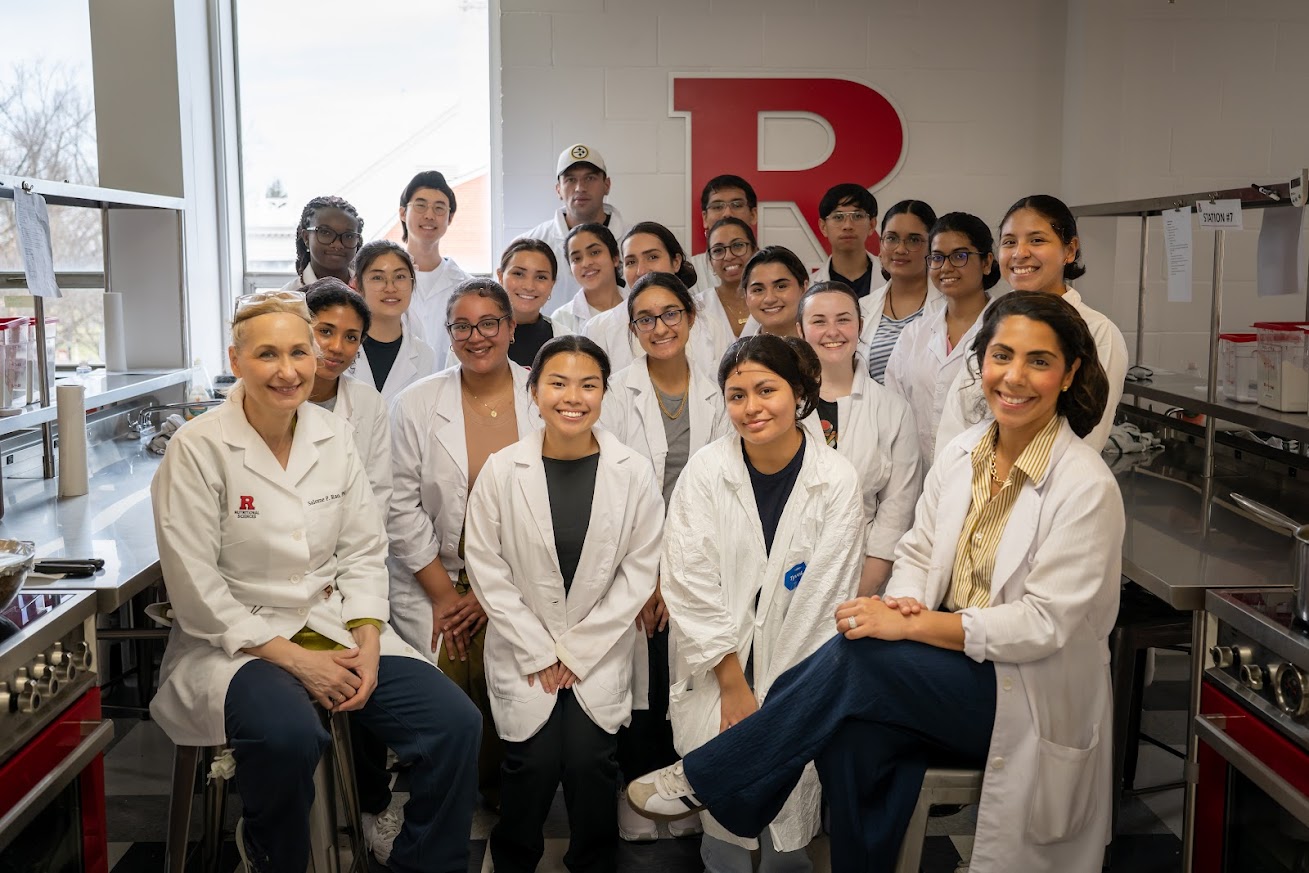
Students and instructors in the Spring 2026 “Food Production and Management†class pose for a group picture on Recipe Day, where the students created meals for the EFNEP website and beyond. Photo: OPOC
On March 11, the teaching kitchen of the Department of Nutritional Sciences at Rutgers University–New Brunswick was filled with the aromas of simmering soups, roasted spices and baked desserts as students put their coursework into action during Recipe Day—a hands-on capstone experience with impact far beyond the classroom.
The event featured 24 student-developed recipes spanning entrées, snacks, soups and desserts, each designed with a clear purpose: to serve low- and under-resourced communities through the Expanded Food and Nutrition Education Program (EFNEP).

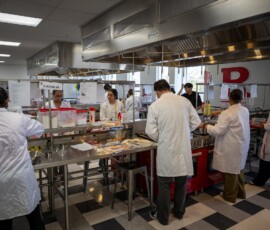
Salome Papaspyrou Rao, assistant teaching professor in the Department of Nutritional Sciences, overseeing the workstations in the Teaching Kitchen during the Spring 2026 Recipe Day.
“This is not just about creating recipes,†said Melissa Keresztes, teaching kitchen coordinator and lecturer. “It's about developing a greater quantity and diversity of recipes using ingredients that are easy to find and that are affordable.â€
Recipe Day is a signature component of the course, Food Production and Management, taught by Salome Papaspyrou Rao, assistant teaching professor in the Department of Nutritional Sciences. The course is designed to align with real-world food systems and community needs while advancing Rutgers' commitment to experiential learning.
Students in the course develop competencies across a wide range of areas, including food procurement, production and distribution systems; kitchen design and large-scale food preparation; menu planning for diverse populations; and food service management, leadership and operations. The curriculum also emphasizes sustainability and cultural competence—key elements reflected in the recipes students create.
The initiative is further supported by Joshua Miller, chair of the Department of Nutritional Sciences, whose investment in ingredients and program resources enables students to fully engage in the teaching kitchen environment while integrating advanced tools for recipe development.
Recipe Day represents the culmination of a unique collaboration between the Department of Nutritional Sciences and EFNEP under Rutgers Cooperative Extension (RCE)—a partnership intentionally designed to align with student success goals in Rutgers' Academic Master Plan, said Marisol Ortiz, EFNEP state coordinator/assistant director, supervisor. The collaboration began with a simple but powerful realization: students and EFNEP staff were already doing similar work—developing and testing recipes—just separately.

L-R: Salome Papaspyrou Rao, Department of Nutritional Sciences; Marisol Ortiz, EFNEP; Melissa Keresztes, Teaching Kitchen; and Stacy Onofrietti, EFNEP. Photo: OPOC
“That prompted me to reflect on the proximity and overlap between EFNEP and the Department of Nutritional Sciences,†Ortiz said. “We saw an opportunity to bring those efforts together in a way that benefits both students and the communities we serve.â€
By integrating EFNEP into the classroom, students gain hands-on, service-learning experience while contributing to a growing national library of culturally relevant, nutritious and cost-effective recipes.
EFNEP representatives Ortiz and Stacy Onofrietti, EFNEP program associate and supervisor, visit the class to introduce their programming and outline opportunities for student involvement in recipe development. According to Ortiz, they also provide specific criteria for recipe creation tailored to the communities they serve, including an emphasis on cultural diversity, affordability, and the use of readily available ingredients
“For their initial assignment, students are encouraged to explore original recipes, often drawing inspiration from personal or family traditions that are meaningful to them,†Ortiz said.
Students also learn that “in addition to the recipes being incorporated into EFNEP classes and showcased on our website, one recipe is selected for inclusion in an EFNEP recipe book developed in North Carolina,†she added.
Precision Meets Creativity in the Kitchen
Students are tasked with creating recipes that meet strict EFNEP guidelines, including limits on sodium and fat, a maximum of 10 ingredients and the use of accessible, low-cost foods commonly found in grocery stores or home food pantries.

Student Jacquelin Genty cooks an entrée of unstuffed cabbage with rice. Photo: OPOC
To meet these standards, students use nutrient analysis software to generate USDA-compliant nutrition labels and refine their recipes accordingly.
For student Mia Harris, that meant reworking a sweet potato spice granola recipe—adding ingredients like honey and pecans while ensuring it still met program requirements.
The process is both technical and creative, requiring students to balance flavor, nutrition and affordability. Many students drew inspiration from their own cultural backgrounds, resulting in a menu that reflects the diversity of the communities EFNEP serves.
Jacquelin Genty, who transferred to Rutgers in 2024, is creating two items. One snack, specifically a crispy, roasted chickpea, and an entrée of unstuffed cabbage with rice.
Jennifer Reyes reimagined a Dominican-inspired plantain lasagna, adapted from pastelón, a family favorite.

Raoul Bernal, SAS'27, preparing chicken tinola, a traditional Filipino soup.
Raoul Bernal, SAS'27, prepared chicken tinola, a traditional Filipino comfort soup. For him, the recipe as well as the experience are personal. “It's a huge comfort food my mother used to make when we were sick,†he said, describing the familiar flavors of ginger, chicken and chayote.
The Simple Plate Initiative as a National Resource
Recipes developed during the course undergo rigorous testing, including step-by-step documentation, yield calculations and sensory evaluations. Once finalized, they are reviewed by EFNEP staff and selected for use in community programming and online publication.
Over time, these student-created recipes have extended their reach well beyond New Jersey—some even appearing in EFNEP materials used in other states.
“This collaborative work beautifully illustrates how Cooperative Extension and academic instruction can work synergistically to meet community needs while enriching students' experience,†said Brian Schilling, RCE director.
Now entering its third year, the program is officially named the Simple Plate Initiative and continues to expand under the leadership of EFNEP's Onofrietti. “Students are encouraged to create unique, culturally diverse recipes using ingredients commonly found in local food pantries, helping to inclusively represent the populations we serve,†she said.
“This initiative connects academic learning with real-world impact,†Ortiz added. “Students are not just completing assignments—they are creating resources that directly benefit families across the country.â€
Beyond technical skills, students leave the course with something more enduring: a sense of purpose and pride.
With their names attached to published recipes and a tangible contribution to community health, students build professional portfolios while seeing firsthand how their work can make a difference, stressed Keresztes, as she moved between stations of students gathered around the Ferrari red kitchen ranges and ovens of the Nutritional Sciences Teaching Kitchen.
And among the aromas and sounds in the bustling kitchen, it's easy to see that Recipe Day is indeed more than a class exercise. It's where education, culture and community come together.


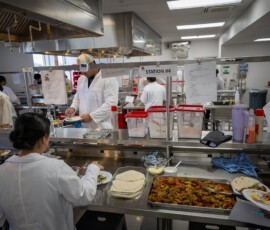


Salome Papaspyrou Rao, assistant teaching professor in the Department of Nutritional Sciences, overseeing the food preparation. Photo: OPOC


Jacquelin Genty cooks an entrée of unstuffed cabbage with rice. Photo: OPOC


Salome Papaspyrou Rao, assistant teaching professor in the Department of Nutritional Sciences, overseeing the workstations in the Teaching Kitchen during the Spring 2026 Recipe Day.



Â


