When the United States opened its doors to Bosnian refugees escaping genocide and civil war in the 1990s, St. Louis welcomed thousands to help boost its declining population.
Today, the region boasts one of the largest Bosnian communities in the world.
And that community has had a lot to boast about recently, with the city hosting the Bosnia and Herzegovina national soccer team in the lead-up to its World Cup appearance.
Nermana Huskić is a soccer fan and refugee who's been in St. Louis since 1998 and founded a nonprofit serving St. Louis and Bosnian families. She sat down with STLPR's Abby Llorico to talk about how this moment is helping people reconnect with their culture.
This interview has been edited for clarity and length.
Abby Llorico: I recognize that you cannot speak for the entirety of the Bosnian or Bosnian St. Louis community – but how would you describe Bosnian culture for those who are unacquainted?
Nermana Huskić: I think no matter where we are, and for generations and generations, Bosnian people have been known for their generosity. Our people will come together whenever there’s a need for anything happening, here in St. Louis or overseas. Our cleanliness. We love beauty, we love beautiful things, we keep up with our appearances, our homes. The hospitality: When you come into our house, you will always be offered food, snacks, drinks, and most of the time, you can’t refuse.

Brian Munoz
/
St. Louis Public Radio
Llorico: A lot of us know factually about the big Bosnian culture here, and especially in the Bevo area, now really in south St. Louis County, but we might not realize the ways in which the Bosnian community has made its mark on St. Louis. Can you provide examples of that?
Huskić: There are many different businesses, a lot of times people won’t even notice they’re dealing with a Bosnian, but I feel like our community is so diverse, you have somebody in every career, in every business. I feel like that has brought up the economy.
Llorico: Numbers alone are an important contribution to a region – I think we would realize if we didn’t have this big population here.
Huskić: Yeah, definitely.
Llorico: There’s Bosnian, there’s St. Louisan: how about this community of Bosnian St. Louisans? Is there a uniqueness to that particular culture of the refugees and their families who’ve made this Midwest town home?
Huskić: Of course. Your identity is no longer just I’m just Bosnian, you’re Bosnian American. You pick up on the things like how people always joke when you ask, like, “what school did you go to,” you know, that’s like a St. Louis thing. Well, we’re just like that, too. And if we go overseas, we are different than the Bosnians that are there, because now we have another identity with our first identity.
Brian Munoz
/
St. Louis Public Radio

Brian Munoz
/
St. Louis Public Radio
Llorico: Can you think of any examples of that, where you felt like a St. Louisan among Bosnians?
Huskić: Parking is just like a crazy thing – like even coming here, I asked you, where should I park, because there’s designated places to park. When we go to Bosnia, we look for designated places to park, and the Bosnians are just going to put their hazard lights on and park right in the middle of the street.
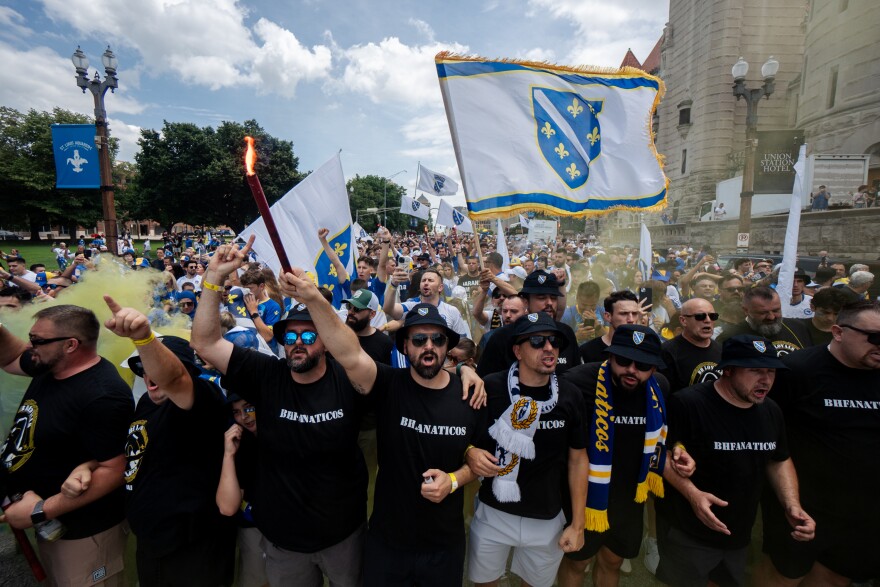
Llorico: What does it mean for the Bosnian community to come together for events like the World Cup run, and even to see other people who aren’t Bosnian wearing the blue and yellow?
Huskić: We love that, my god, we love that. I can’t speak for other cultures, other people, but we love to see anybody in our jersey, in our cultural wear, like anything. If someone speaks two words of Bosnian, we’re like, ‘You are genius! You’re amazing!' So, we love it. Bosnia being in the World Cup is just something that’s so amazing. Last time (in 2014), we were rallying and all of that, but this time there are a lot of players that were born outside of Bosnia, and then they’re playing for Bosnia. So now this also gives a bigger connection to the Bosnian Americans that were born here, because it’s like there is somebody that’s like me, representing me. His Bosnian is not perfect; he’s trying, so the other kids are like, “My Bosnian, maybe it’s not perfect, but I’m trying,” and so it might encourage them to feel more comfortable speaking Bosnian, and also to have that dream that they can also make it.
The Bosnia and Herzegovina national team plays Canada at 2:00 p.m. CST on Friday.