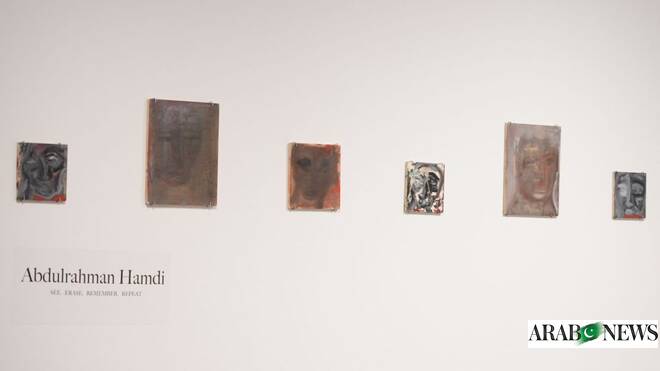
JEDDAH: Saudi art has found a new audience with “Refusal,†an audiovisual installation by Saudi artist Abdulrahman Hamdi which is being displayed on the facade of the iconic The Mart in Chicago.
ART on THE MART is an exhibition engaging the building's monumental architecture as a fixed, enduring surface, with unstable visual imagery and rhythmic sound patterns moving across it.
Hamdi, a Saudi multidisciplinary artist currently pursuing a master's in fine arts in painting and drawing at the School of the Art Institute of Chicago, said he seeks to represent Saudi art and culture on the global stage to challenge stereotypes.
He told Arab News: “I cannot imagine the trajectory my life would be on without them (the art institute) and the ministry. In a way, they've been my partner on this path, and I take my role seriously.
“From day one I've sought to represent Saudi art and culture, to introduce our creative spirit to the larger world, and shatter stereotypes.â€
His participation in Chicago, he added, reflected a wider shift in global artistic perception.
He said: “My place in Chicago, then, signals that the larger art world is eager to hear Saudi artistic voices and, more importantly, understand them.
“This is a remarkable institutional shift that I hope will be replicated across the West.â€
Hamdi noted that his experience of Saudi Arabia and the US had shaped his understanding of identity and visibility.
He said: “I observe a lot of similarities between Saudi Arabia and Chicago. Both are places frequently misunderstood.
“In both places, then, it's important to be visible, to let the world know the creative spark is alive.â€
His practice often explores emotional memory, introspection, and inherited silence.
He added: “Vulnerability means solitude. I dove into my mind's eye, alone. I was curious enough to explore my thoughts, but unsure how to outwardly show that thinking.
“So, I did repress that thinking, a common reflex in what for centuries has been a tradition and honor-bound society.â€
He added that painting served as both a form of confrontation and healing, saying: “It's first an act of confrontation, of being alone with my thoughts, my history, my choices. Then, through the creative process, painting becomes healing.â€
Hamdi also emphasized the importance of complexity and concealment in his visual language, and added: “Art isn't easy. I want my audience to linger at work … to gaze once, return, gaze again and see something entirely different. For me, to be overt would be admitting defeat.â€
Poetry, he said, played a central role in shaping his visual atmosphere.
“I use the emotions I gain from poetry to select colors and direct stroke,†he said, adding that painting and poetry both functioned as emotional translation.
He also reflected on silence as a conceptual force in his work.
He said: “My work is silent because it is not overt. Silence … is powerful and it commands the audience to listen to their heart and mind. Silence can speak quite loudly.â€
Hamdi described paradox as a recurring theme in his practice, including in his use of imagery such as dogs.
“Dogs are another paradox,†he said, noting how they shifted between cultural reverence and rejection, and how this tension informed interpretation.
On audience reception, he said that the variability of interpretation was the focus of his work.
He added: “The greatest revelation is how people see the same work, yet minutes later they recall it differently, and their interpretations can be so divergent.â€
He positioned his practice within the evolving Saudi art landscape, saying: “I am still Saudi. And what I produce is representative of my culture. I hope my practice will encourage artists across Saudi to think differently and expansively.â€
Hamdi added that his goal was to broaden international understanding of contemporary Saudi culture.
He said: “My goal is for Chicago audiences, and all Western people, to know that Saudi interior life, creative capital, art and culture are thriving.â€
Tahani Al-Baiz, Saudi cultural attache to the US and Canada, congratulated Hamdi on his achievement, and noted that the participation of Saudi creatives on prominent international platforms reflected the artistic and intellectual capabilities of Saudi men and women and strengthened the Kingdom's cultural presence globally.