
Moving to Israel, making aliyah, might change a person. It might even influence what a person cooks and eats. Several former Detroiters tell of their transformations and share recipes.
Tamara “Tami†Golan experienced a food shift. As a young teacher, Golan came to Migdal HaEmek, in the Detroit Partnership area, from Michigan for a yearlong educational trip, one of the Israel experience programs of MASA. The organizers found her an apartment right near the shuk, the city's open-air market.
She recalls, “I would go on Tuesdays and just buy all the fresh fruits and vegetables and grains. I felt like a kid in a candy store, but the candy was fruit and vegetables.â€Â
When Golan says, “Everything was so fresh and so cheap,†she pronounces the word “fresh†with reverence. That year, she realized she much preferred to cook with fruits and vegetables. She did not even like touching raw meat.
“So, I became vegetarian. I would just buy all these wonderful things from the shuk and that's what I would use for my meal prep, for my cooking, for my everything for the week.
“Once in a while, if I really wanted a hamburger, I would go out with my friends to BBB [an Israeli burger chain].
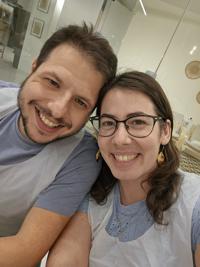
Rami and Tamara Golan
“It is not like it was for any ideological reason or for any specific health reason. It was just having that access to this incredible fresh food that changed how I ate for a few years.â€Â
Later, she met her husband, Omri, a native Israeli and a committed carnivore. According to Tami, they joke: “If he does not eat meat in a day, he is hungry.†They always keep servings of chicken or beef in the freezer, so he can have at least one serving of meat a day.
“In the U.S., things like chips and processed food are the cheap food. And everyone has them in their closets,†she says. In Israel, the Golans have a fruit basket on their kitchen island, and they make sure it stays full. “If I want a snack, I go and grab a clementine; I go and grab an apple.â€Â
Golan now works as external relations and resource development for the Daniel Centers, a group of Reform synagogues in and around Tel Aviv. She coordinates visits from Reform synagogues across the USA for Kabbalat Shabbat, Friday night dinners and lessons with the rabbi; she arranges for the rabbi to teach overseas as scholar-in-residence; and she does fundraising.
Golan gives a shout-out to her mother, Gail Greenberg, who worked for the Jewish Federation for 17 years, and now serves as the education director of lifelong learning and Yachad at Temple Emanu-El in Oak Park.Â
She recalls that at a café, on her second date with Omri, he ordered shakshuka, a tomato-based egg dish. They decided shakshuka “is something you should never order in a restaurant.†Make it at home, she says.
To illustrate eating like an Israeli, Tami did not send a recipe for shakshuka. Instead, she sent a recipe for fire-roasted eggplant, part of an Israeli-style breakfast with fresh schug (a spicy dip of ground hot green peppers in olive oil with herbs), guacamole, strawberries and fresh-squeezed orange juice. Ingredients are from her local fruit and vegetable store.
FIRE-ROASTED EGGPLANT
From Tami Golan
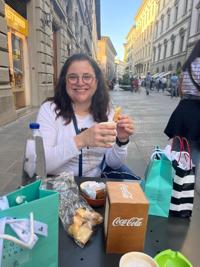
Rivky Schramm Krestt
Note: Readers can easily make fire-roasted eggplant at home. Depending on the weather, we either make it on the barbeque outside or on our gas stove. You do need a real fire source, not just a heat source, so an electric stove or induction stove won't work.
Â
Ingredients
1 large eggplant
Garnishes: salt, pepper, tahini, schug and pomegranate molasses
Â
Directions:
If making this on a gas stove inside, we usually cover the stove in aluminum foil, so when the juices from the eggplant drip, it makes for easy clean up.
Turn the gas stove onto the highest heat and lay the eggplant directly onto the flame. No pan or anything.
Allow the skin to burn and char, and then flip the eggplant, allowing every side time for the skin to char. Don't be afraid to really burn it. The actual flesh inside the eggplant won't burn!
Once the eggplant is completely well charred, lay it flat on a plate, and slice it directly down the middle. Flay it out to both sides.
We top ours with salt, pepper, tahini, schug and pomegranate molasses.
Sim Zacks At the Smoker
Sim Zacks made aliyah from Michigan 22 years ago with his wife and four young children. He works in high-tech. “Irony of ironies,†he says, “I am now working for General Motors.â€
Zacks made a different culinary transition. A few years ago, as he recounts, his wife told him he needed a hobby and told him, “You can't have a hobby that you don't do … skydiving is only a valid hobby if you jump out of an airplane, right? If you don't, then it's not a hobby. It's just something that you would have liked to do.â€
So, he bought a smoker. He learned about the different cuts of meat available from butchers in Israel. He found a supplier and purchased one bag of nitrate salt, not readily available in Israel, but enough, because “you need just a little bit for each thing you do.†He has made corned beef, pastrami and salami.
Clicking around on YouTube, he found video instructions for making beef bacon. It was not a kosher thing; they just used the belly of a cow. He found the cut of meat he needed: asado. He looked up the recipe, and “it was so super simple that I was, like, let's try this.â€
BEEF BACON
from Sim Zack

Frying up the Beef Bacon
Ingredients
Asado cut of beef (from the belly)
1¼ tsp. brown sugar
¾ tsp. paprika
2½ tsp. kosher salt
¼ tsp. nitrogen salt
Directions
Mix the spices together and rub it on top of the meat, then wrap it in plastic wrap and refrigerate. Once a day for five days, turn the meat over in the fridge and rub it.
In a smoker, cook it until a meat thermometer reaches 145 degrees Fahrenheit, remove from smoker and let it rest for three minutes or more. Then put it in the fridge for a while, because it does not cut well hot. When cool, slice it really thin. Zacks uses an electric slicer. Then fry it in its own fat until it gets crispy. It is basically very salty smoked meat. You can't eat a lot of it straight, but it's great if you crumble it and cut it into tiny pieces to add to roasted potatoes and salad.
Locally Grown Fruits & Veggies
Shaina Shevin Warshay made aliyah with her husband and four children in July 2019. She works as a medical secretary. She notes differences between food shopping in Michigan and Israel: In Israel, stores carry locally grown fruits and vegetables, almost always during the season.
“Strawberry season [winter!] is a big deal in this house,†she says. “Chicken soup has different vegetables, depending on the time of year. Basic carrot, parsnip and celery in the U.S. gave way to those plus the seasonal turnip and parsley root, kohlrabi, light green squash instead of the more expensive zucchini and onion.
“I sometimes use hawaj (a spice mix with turmeric, cumin, cardamom and black pepper), sometimes also saffron, coriander and other spices in the soup for a slightly different flavor. “I also use more Mediterranean spices — cumin, turmeric,hawaj — in my cooking in general,†she says.
Warshay says she was introduced to Sephardi cuisine from visiting neighbors in Israel. Her favorite recipe is Hawaj Chicken — bone-in thighs and legs drizzled with honey, sprinkled with hawaj and roasted.
Â
Her Cooking Transformed
Rivky Schramm Krestt grew up in Southfield and moved to Israel from Silver Spring, Maryland, in 2012, settling in Efrat with her family. She lists the way her cooking has changed since moving to Israel:
• “The big three spices that changed my kitchen are cumin, tamarind and preserved lemon. Tamarind has a unique sweet-sour depth that's hard to describe until you taste it. Preserved lemon adds a briny, bright punch that's hard to replicate with fresh lemon. Cumin I always knew, but I use it far more generously now.â€
• “Roasted vegetables are transformed — especially eggplant and chickpeas. I grew up knowing eggplant only from ratatouille, which I didn't even like! Now I roast it, grill it, make it into salad. Roasted chickpeas with cumin are a favorite — I buy a frozen 500-gram bag and they serve as a garnish, a snack and, at one point, kept my daughter fed during her vegan phase. And then there's tamarind beet salad, which I first had at someone's house and fell completely in love with.
“One interesting detail: There's a new place in Efrat whose tagline is “bringing back Ashkenazi soul food†— they even serve Prohibition-style pickles. So, it goes both ways: I've absorbed more Middle Eastern cooking and, at the same time, there's a local nostalgia movement reclaiming Ashkenazi flavors.â€
Krestt adds that “the style of cooking is also different.â€
“People think nothing of doing a backyard BBQ for lunch [on the biblical festivals, observed for only one day in Israel]— far less formal than the elaborate preparations I grew up with. Even for Rosh Hashanah, which is still two days and involves a lot of food, I've started doing a sandwich bar rather than a sit-down meal. Less pressure and people love picking exactly what they want.
“I'm not sure how much of this is an Israel thing versus just changing times — but I'll say that many of my neighbors do the same, so something is definitely in the air.â€
Krestt is a Jewish educator. She serves as an instructional designer and Judaic curriculum specialist at YU Global and teaches at Midreshet Lindenbaum.
Fourteen years after making aliyah, her “family has grown to include one ornery dog and one wonderful son-in-law.â€