
Â
Kerri DiPietro, chief quality officer at Integra LifeSciences, spoke at the RAPS Quality Conference. (credit: Ferdous Al-Faruque)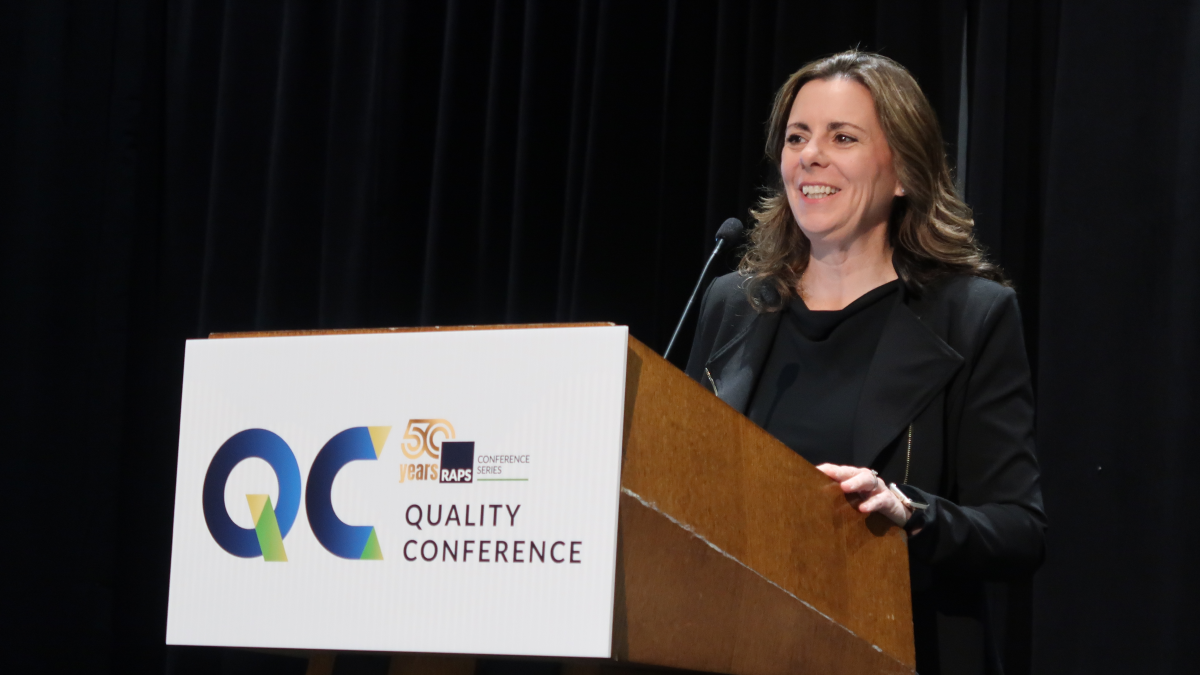
BALTIMORE – Kerri DiPietro, chief quality officer at Integra LifeSciences, said that drug and device makers need to be methodical and purposeful when considering elevating their companies’ quality cultures. She noted that it involves getting buy-in from key leadership, measuring the progress, and implementing a plan that may take years to accomplish.
Sean Boyd, corporate vice president at QualityHub, introduced DiPietro during the opening plenary at the RAPS Quality Conference, where DiPietro advised attendees on improving their quality culture.
Prior to his role at QualityHub, Boyd served at FDA for more than 30 years in various positions, most recently as director of the Office of Regulatory Programs within the Center for Devices and Radiological Health. Boyd emphasized the importance regulators put on a company's quality culture and said it was one of the key questions they would ask company executives about. More specifically, he said FDA would ask how they evaluate and assess quality within their company and how they intend to make improvements.
“There were several initiatives that remain ongoing today about establishing a quality culture and making the case for quality,” said Boyd.
DiPietro said building a quality culture is really about values and ownership and about going beyond minimum compliance requirements rather than blindly following the rules. She said it’s about creating a shared mindset where quality becomes a core value of the company.
Levels of compliance
Before you can develop a quality culture, DiPietro said it’s important to step back and understand where the company stands in terms of its quality culture and where it wants to go. She presented five levels of compliance that companies typically follow and asked attendees where they think their companies fit.
DiPietro noted that the first level of compliance is reactive, driven by external events, and leads to frequent recurrence of corrective and preventive actions (CAPA), with quality based on training and the company simply checking boxes. The second level is based on controlled compliance, with documented processes, basic controls, and improved audit preparation. While this reduces the need for CAPAs, she noted that quality issues tend to recur across sites.
The third level of compliance uses a proactive, risk-based quality system with more rigorous investigations, DiPietro said, leading to fewer compliance issues and stronger key performance indicators. At the fourth level of compliance, she noted that companies have a more integrated quality culture, taking ownership of quality across functions, which leads to more effective CAPAs and better overall outcomes. Finally, she noted that the fifth level of compliance tends to be an optimized state in which the company uses predictive quality based on leading indicators to continuously improve.
When attendees at the meeting were polled, 41% said their companies followed the second level of compliance, and only 3% said their companies met the fifth level.
“The whole point of this is, if you don’t know where you are, it’s very hard to get to where you’re going,” said DiPietro. “These conversations can be really challenging because they require an enormous amount of self-reflection, not just from you, but from the organization as a whole; from R&D, from operations, from quality.
“This is a journey you can’t go on your own,” she added.
Areas of focus
According to DiPietro, companies that want to change their quality culture need to focus on six areas, including their structure, systems and measures, behaviors, skills and people. However, she emphasized that it all starts with their vision and strategy.
“Does the company’s vision and strategy reflect the fact that you want to go on this cultural transformation?” DiPietro asked. “Has the company stated its intent? Are you getting all of the leaders to align somehow, even in a small way or a big way, to serving your customers and your patients or your end-user in a better way?”
Making the change
DiPietro said that changing company culture can be overwhelming and that it doesn’t happen in days but takes years. However, the first step is to develop a plan for how the company will change its quality culture. She said the plan should include assessing the current state of the culture, establishing a cross-functional roadmap, and finally getting leadership to use the right language and to exude the right behaviors that align with the company’s desired outcome.
In the next step of transforming a company’s quality culture, DiPietro said the company needs indicators to evaluate how it is changing its culture and then deploy a governance structure to implement those changes. After implementing changes, she said leadership should reward the changes and constantly reevaluate where they are.
“Every time a new leader comes in, you buy a new company, go through a transformation, maybe you have some external disruptor you didn’t plan for, all those things can impact your culture, and it’s a commitment that you don’t just make once, you make it continuously, and you have to really be vigilant to say, ‘Where are we, how are we doing,'” said DiPietro.
“Think about where you are and think about where you want to go and how planful you can be at that and how you have to do a little bit of a marketing job and really bring people along with you in the journey,” she added.
RAPS Quality Conference