
It's got everything: Rothkos and rednecks, eminent healthcare think tanks, and the highest maternal mortality rate in the country, a viciously anti-trans governor, and a town filled with drag queens and Pride flags. America in 2026 is, of course, a land of extreme contrasts. In the Arkansas corridor from Little Rock to Bentonville—where the Crystal Bridges Museum of American Art opens an ambitious 114,000-square-foot expansion on June 6—those extremes are in very close proximity.
I have been to Arkansas a dozen times. My first roommate in New York was from Wilmot, a moldering hamlet in the Mississippi Delta. He liked to drawl that you could see his family's vast catfish farms from the moon. Last fall, I decided to take a road trip through the Arkansas Ozarks. I flew to Little Rock to visit the Arkansas Museum of Fine Arts and its new Studio Gang-designed building. Friends of mine were instrumental in raising the $150 million it took to build the elegant new structure, and are committed to bringing high-quality visual culture to Little Rock. I stayed at the Capital Hotel, with its legendary huge elevators. The story is that Ulysses S. Grant required the giant elevator to bring his beloved horse upstairs to stand outside his hotel room as he slept. That's a fabrication—though he did stay at the hotel and proclaimed in a speech at Concordia Hall on April 14, 1880 that, “all foreigners find a welcome here. We make them American citizens. After we receive them, it is but one generation until they are Americans.â€
Leaving Little Rock, I drove up Highway 65 toward Eureka Springs. After about three and a half hours of flat plains shifting into gentle hills, it's a dramatic climb into the Ozark highlands. Famished carnivores should head to Coursey's Smoked Meats, which is just outside the hamlet of St. Joe, a once prosperous mining crossroads that now claims a population of around 130. (It is also a major access point to the Buffalo River for hiking, floating, fishing, canoeing, camping, and zip-lining.) Coursey's is to Arkansas what Zabar's is to the Upper West Side—a legendary fifth-generation smokehouse and sandwich counter with a small, unforgiving menu. White bread with smoked turkey or ham and smoked Swiss or smoked cheddar, got it?
A Dark History and Transcendent Architecture
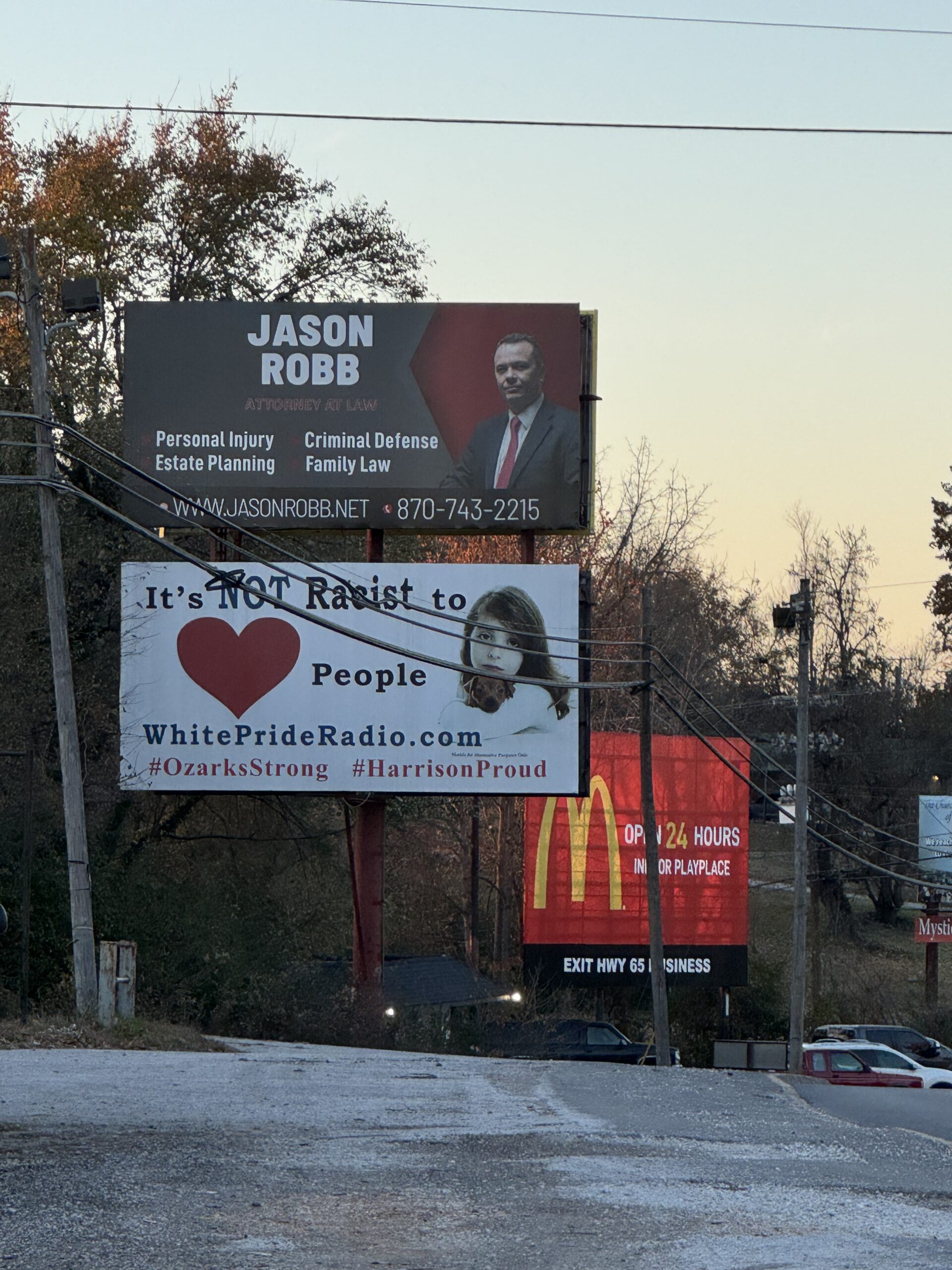
About 40 miles northwest of Marshall, you begin to slide back into the grim monotony of commercial roadside blight—liquor stores, raggedy churches, gas stations. As I drove past all this detritus, some part of my rusty amygdala flashed red: that billboard didn't really say “White Pride,†did it? I doubled back to the billboard, which advertised the services of a weak-chinned lawyer with a protruding, bony forehead named Jason Robb on top and “White Pride Radio†below. “It's not racist to [red heart] people†it proclaims, across an image of a young teenage girl.
“Olympian Brows†such as Robb's are often associated with congenital syphilis. While I have no insight into his health, it is well documented that Robb is the son of Pastor Thomas Robb, the “national director†(formerly Imperial Wizard) of the KKK and is, alongside his sister, involved in the organization. Harrison used to have five white supremacist billboards, but the Harrison County Task Force on Race Relations, the main opposition to the vile adverts, has managed to have them all removed, apart from this one, which is located on Robb-owned land. The anti-racist campaign, “Love Your Neighbor†has its own billboards to combat the reputation of their town as “the most racist in America.â€
Speeding north along Highway 62, you're deep in the hills of Ozark country. Eventually, the road snakes and climbs and you'll see a sign for Thorncrown Chapel designed by E. Fay Jones. Stop here. This is a must-do on your journey to Northwest Arkansas; it reset my troubled thoughts. Jones is the only Frank Lloyd Wright acolyte to win the American Institute of Architects' highest honor and yet remains relatively unknown. Northwest Arkansas is where you'll see the best examples of his work.
Thorncrown, built in 1979-80, is set in a glade of pine, oak, and maple trees against a moss-strewn hill with rocky outcrops. It looks almost impermanent; a pellucid treehouse skinned in a geometric web of glass planes and bark-gray wooden columns and crossbeams rising to a pitched roof. Although it is nearly 50 feet tall, the chapel is sometimes barely visible, depending on the light. Â
The simple rows of pews, the floor of flagstone slab, the trusses and hewn pine columns, stained gray to match the trees outside, were all made by local craftsmen. In Celtic Christianity, a caol ait (“thin placeâ€) is a locale where the boundary between the natural and supernatural worlds collide. Thorncrown is a thin place, yet to me, it is more Shinto than sacrament. Jones wanted everyone to be welcome here and “to think their loftiest and best thoughts.â€
Little Switzerland Meets Christ of the Ozarks
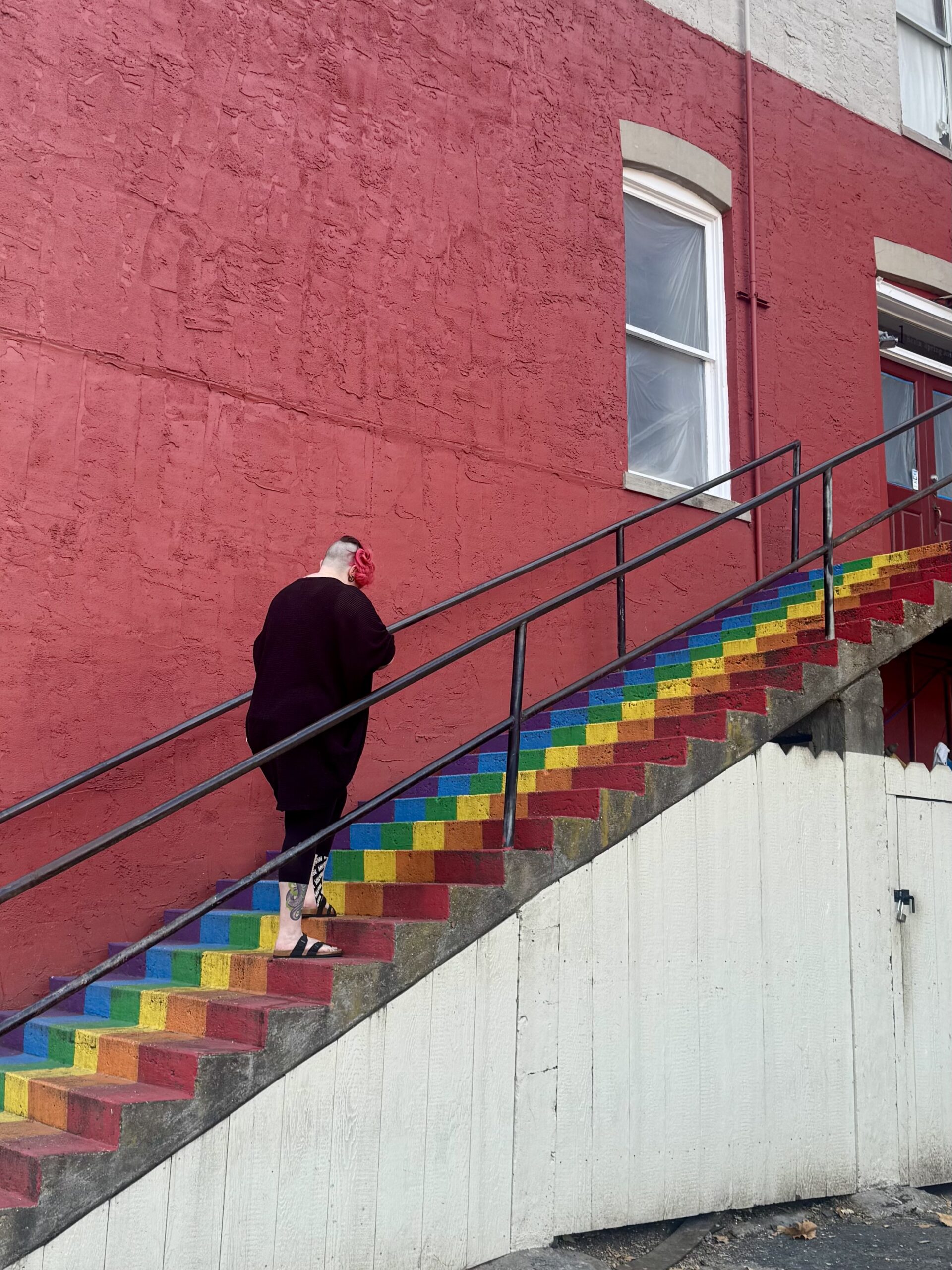
Just a few miles' drive further, you pitch over a hill and into Eureka Springs, a Victorian spa town crouched in a ravine at the headwaters of Leatherwood Creek, an offshoot of the White River. This is a village with no right angles, no stoplights, drag queens on every corner promoting their shows, and rainbow-colored stairs that connect three levels of the late 19th century town. Sixty mountainside springs gave the town its moniker “Little Switzerland of the Ozarks.†Today, a quarter of the 2,000 inhabitants are artists and writers. A third identify as LGBTQ+. I stayed the night at the spartan and friendly Wanderoo Lodge, just outside of downtown and owned by a gay couple from Dallas.
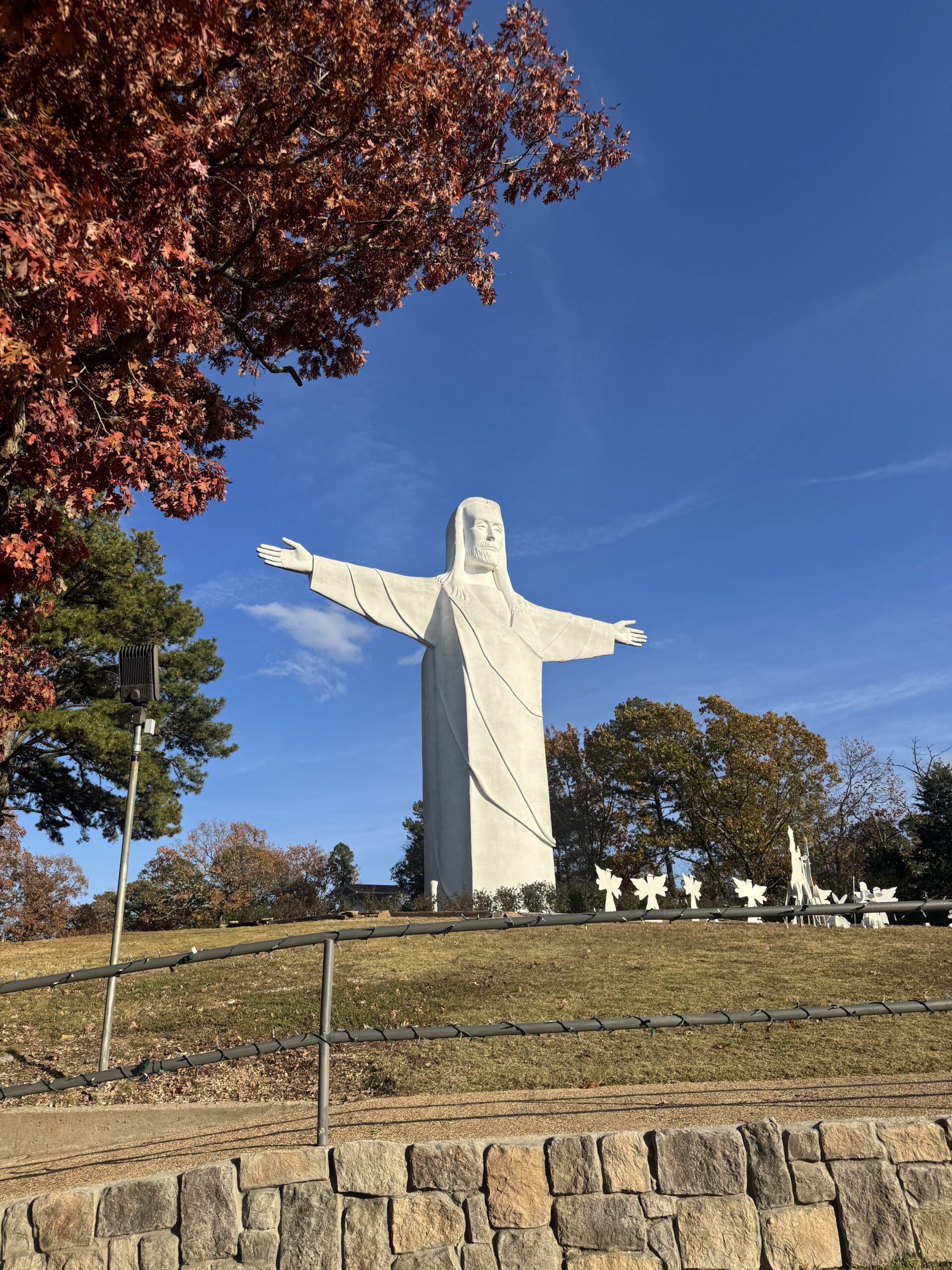
If it's not clear by now, Arkansas demands balance—and if you think you're going to get sublime spirituality and a town full of glamorous queens and Victorian mansions for nothing, you are mistaken. I woke up early to explore what for me is the shadow side of Eureka. Two miles from downtown Eureka Springs looms a 67-foot-tall, two-million-pound, gleaming white statue of Jesus called Christ of the Ozarks made by Emmet Sullivan in 1966. It glowers like a constipated high school principal atop Magnetic Mountain and can be seen for 20 miles in any direction. Sullivan was a very bad artist, hitherto mostly known in the environs of South Dakota as a sculptor of clumsy, monumental dinosaurs. His magnum opus here in Eureka has been called “Gumby Christ†and compared to a milk carton with arms.
The statue was commissioned by racist and antisemitic demagogue and failed presidential candidate Gerald L.K. Smith, who founded the original America First Party in 1944. He believed Presidents Roosevelt and Truman were secretly Jewish and that Jews should be deported and sterilized. After enjoying immense popularity in the 1930s and '40s, Smith eventually skulked off to Eureka with his wife Elna. The 2018 documentary The Gospel of Eureka explores this yin and yang of Southern queens and gonzo Christians and is narrated by cabaret diva Mx Justin Vivian Bond who, incidentally, officiated my wedding.
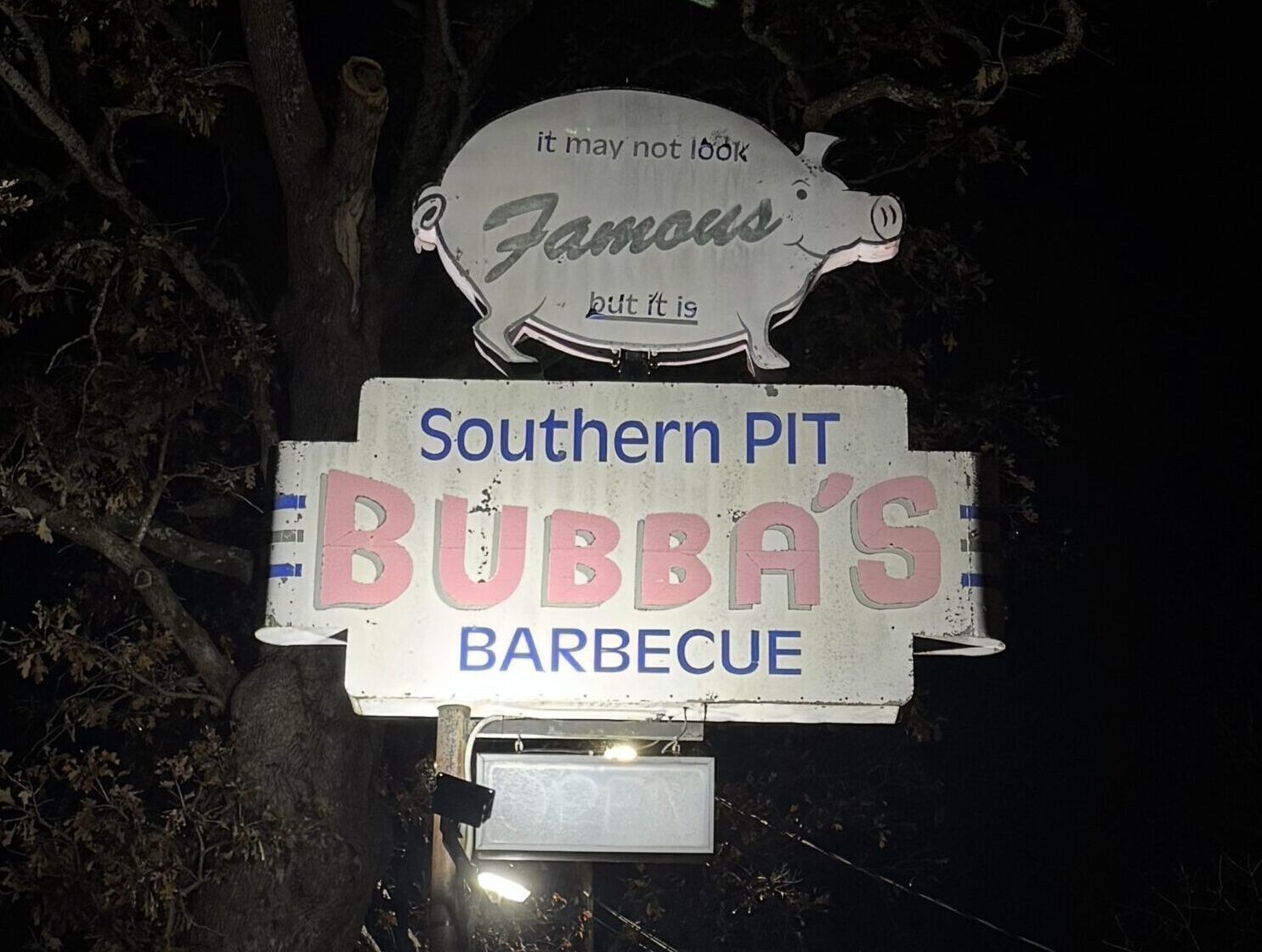
While constructing their peckerwood colossus, the Smiths decided to construct a mock Holy Land that would serve as a setting for a never-ending series of outdoor performances of the Great Passion Play. I parked next to a grungy dog lingering around the Second Temple and was relieved that all of the dining options – including Pilate's Grill and Herod's Snow Cone — were closed. I browsed the Bible Museum with its surprisingly impressive display of six thousand holy books, including an original King James Bible from 1611, and the gift shop. The best items were t-shirts with Christianized puns written across mass-market food logos: “Wanna Taco About Jesus?â€.
At this point, I realized I was desperate for good food, culture, and a heavy injection of art and beelined to Bentonville, 40 miles away on Highway 62.
Walmart and High Art
Bentonville is built around a bucolic town square and looks like a movie set. From the outside, Walton's Five and Dime is unchanged from when it opened in 1950, but it's now a museum telling the story of the massive company it became and its flinty, visionary founder Sam Walton. The Walton family still considers this home base and has invested heavily in the town and surrounding area. But the greatest patron of Bentonville is Alice Walton who, with her loyal team, has transformed the entire region into a cultural and intellectual hub.
The heart of Alice's vision is Crystal Bridges Museum of Art, designed by the Israeli-Canadian architect Moshe Safdie. When I first visited in 2014, the museum was just a few years old, having risen out of a spring-fed ravine where Alice scampered around with her brothers as a child. When it opens its Safdie-designed expansion in June, the museum will measure 314,000 square feet across 134 acres.
That's not counting the nearby Momentary, a sort of kunsthalle for temporary exhibitions, the new Whole Health Institute think tank whose mission is to rethink and repair our shambolic health care system, the Alice Walton School of Medicine (“AWSOMâ€), and a trail-looped forest filled with 20th and 21st century sculpture.
The best route to the museum is to walk from the 21C hotel through Compton Gardens, a beautiful park that leads directly into the museum grounds and past James Turrell's Skyspace: The Way of Color, then head past Louise Bourgeois's gigantic spider and Yayoi Kusama's Narcissus Garden, hundreds of shimmering mirrored spheres floating on the surface of Crystal Pond.
Bridges are the guiding principle of the museum, both architecturally and philosophically: even the brawny glass-sheathed concrete and copper-arced Safdie galleries are bridges over water. The entire place is a bridge between art and high culture and a region that once didn't have much of either.
Once in the museum, give yourself at least a day to explore the entire collection. My personal recommendations include Kindred Spirits by Asher Brown Durand, Jimson Weed/White Flower No. 1 by Georgia O'Keeffe, the 1964 Alice Neel portrait of the actor Hugh Hurd, and Kerry James Marshall's masterpiece Our Town.
If you think it's shocking that all of this is in a town of 65,000 people in the northwest corner of Arkansas, you can't imagine the snobbery the museum and its founder attracted when it opened. The Los Angeles Times suggested Alice would be better off buying everyone in Bentonville a house instead of siphoning off great art from coastal collections. The Wall Street Journal claimed that Alice was “a hovering culture vulture, poised to swoop down and seize tasty masterpieces from weak hands.†Something about Arkansas, Alice, and the specter of uneducated commoners flouting around big box stores, impatiently waiting to misapprehend great and undeserved art sent the guardians of coastal elite culture into paroxysms of pearl-clutching rage.Â
Today, the museum draws 800,000 visitors every year and its expansion will double its footprint. Yet most people I know in the art world have still not visited—though they gladly hop on jets to Doha, Gwangju, Taipei, or Menorca.
In a country where we can barely keep bridges from falling and airports operating, standing in front of this museum has the capacity to induce hope. I think Alice's inspiration for the museum and health care initiatives is both deeply American and Arkansan, with roots in ideas of American exceptionalism and the desire to build a “shining city on a hill†(or in a ravine). Â
There are also echoes of that Christian Utopian desire to construct a New Jerusalem. Deep feelings about nature and religion suffuse just about everything in Arkansas. When they join up with values like inclusivity and open dialogue, you get a place like Crystal Bridges and, now, the Museum of Fine Arts in Little Rock.Â
I think of that snaking road between Little Rock and Bentonville as a representation of the hopeful idea that the arc of history, even with its switchbacks and dips, bends toward progress.Â
Stay
The Compton, Bentonville
21C Hotel, Bentonville
Wanderoo Lodge, Eureka Springs
Capital Hotel, Little Rock
Eat
Wrights BBQ, Rogers
Conifer, Bentonville
Preacher's Son, BentonvilleÂ
Onyx Coffee Lab, multiple locations in Northwest Arkansas
Clausey's, Saint Joe
Park Grill, Little Rock
Doe's Eat Place, Little Rock
Watch
Gospel of Eureka
Nine From Little RockÂ
Ozark
Read
Sam Walton, Made in America
Maya Angelou, I Know Why the Caged Bird Sings
Daniel Woodrell, Winters Bone
Jeff Shannon, Shadow Patterns: Reflections on Fay Jones and His Architecture
Robert Adams Ivy, Jr., The Architecture of E. Fay Jones
Â
More of our favorite stories from CULTURED
Danielle Mckinney Shares the Advice That Keeps Her Painting Even on Her Worst Days
What Not Having Mental Imagery Implies for Psychoanalysis, Trauma, and Our Sense of Self
Meet the Woman Who Curated the Art on Miranda Priestly's Walls
Mina Stone's Guide to Eating, Buying, and Cooking With Chocolate (More) Safely
Can Raising Children Make You a Better Artist? Four Artist Mothers Weigh In.
Sign up for our newsletter here to get these stories direct to your inbox.