Over seventy days into the war against Iran, the Islamic Republic is neither defeated, decapitated, nor negotiating from weakness. The most consequential decisions about the next phase of this conflict are being made not in Tehran's civil government but inside a military institution that neither the United States nor Israel had fully understood.
The central analytical failure of the  campaign against Iran was the assumption that destroying its central command would produce “institutional collapse.†The US and Israel designed a decapitation strategy against a military that had spent at least 17 years specifically engineering itself to survive decapitation.
US Gen. Dan Caine, chairman of the Joint Chiefs of Staff, told reporters at a Pentagon press conference on May 4 that Iran’s command structure was “very fractured†and that it was “struggling to maintain control down echelon at the edge.â€Â Nevertheless, the CIA confirmed this week that, even after 70 days of the most intensive American air campaign since Iraq 2003, Iran’s military capacity has not collapsed.
This is because when supreme leader Ali Khamenei was killed on February 28, the system did not pause, panic, or surrender; it activated the “fourth successor protocol,†which designates three to seven replacements for every critical position.
A “fractured†command collapses under sustained pressure. On the other hand, a “distributed†command becomes more resilient under it.

Iran’s Mosaic Defense doctrine, formalized under Islamic Revolutionary Guard Corps commander Mohammad Ali Jafari in 2008, had already restructured the IRGC into 31 provincial commands, one for Greater Tehran and one for each of Iran’s 30 other provinces.Â
Each operates as a self-sustaining military entity with its own intelligence apparatus, weapons stockpiles, communication systems, and pre-delegated authority to act without direction from central command.
The fourth successor protocol designates three to seven replacements for every critical position. When Supreme Leader Khamenei was killed on February 28, the system did not pause, panic nor surrender. It activated.
Iranian Foreign Minister Araghchi confirmed the architecture on March 1 when he wrote: “Our military units are now, in fact, independent and somewhat isolated, and they are acting based on general instructions given to them in advance.†That statement was not an admission of weakness. It was a description of the doctrine executing exactly as designed.
The information war Iran is winning
Iran blocked internet access for its 92 million citizens on February 28, the day the war began. That shutdown has been sustained for 70 consecutive days, the longest recorded internet blackout in Iranian history, imposing an estimated nine billion dollars in economic damage on Iranian businesses.
And yet Iran’s Foreign Minister has posted on X/Twitter daily since February 28. Iran’s parliament speaker has run a financial warfare operation on X/Twitter throughout the conflict. IRGC-linked accounts have posted culturally aware viral animated Lego videos, missile strike claims, and geopolitical analysis throughout the war. Iranian officials have appeared on international podcasts in clear, unaccented English. The government whose country’s internet is dark for its citizens has maintained a perfectly functional global broadcast operation throughout.
This is a controlled broadcast environment with a global microphone and zero domestic accountability. Every statement coming from Iranian officials on X is state-curated messaging that no Iranian citizen can fact-check, contradict, or respond to from inside the country
When Western media amplifies an Iranian government post about ceasefire proposals, missile strikes, or Hormuz status, it is distributing a one-way state broadcast produced behind a digital wall.
The narrative war is being fought with precision. Iran’s civilian government condemns IRGC strikes. The IRGC denies having conducted them. A map claiming military control over UAE territorial waters was released the same day the denial was issued. One rail fires. The other condemns. Both go to the same destination while creating plausible deniability.

What Iran has actually built during the war
Iran has passed parliamentary legislation establishing a new legal framework for the Strait of Hormuz, formalizing its claim to enforce transit authority as a sovereign right rather than a temporary military measure. This legislation does not disappear with a ceasefire. It becomes the foundation for Iran’s permanent maritime governance posture regardless of how the kinetic phase resolves.
IRGC-linked media published this week a formal three-step governance model for the Hormuz submarine internet cables. The cables carry more than $10 trillion in daily financial transactions.Â
The proposal requires foreign operators, specifically naming Google, Meta, and Microsoft, to obtain Iranian permits and pay tolls, operate under Iranian law, and assign maintenance and repair rights exclusively to Iranian companies. This is not a threat. It is a published regulatory framework, legally grounded in Iran’s non-accession to UNCLOS and its claim to sovereign authority over the seabed beneath the strait. Not a single technology company listed on the NYSE and London Stock Exchange with Gulf data center exposure has priced this risk into current valuations.
Iran has simultaneously rerouted its trade architecture away from UAE ports and toward Pakistan’s Gwadar port, a facility operated by China under the Belt and Road Initiative. Approximately $45 billion in annual Iranian trade that previously flowed through Dubai’s Jebel Ali is now redirecting through a Chinese-operated port in a nuclear-armed state, which Washington needs as its primary peace broker.
The blockade that was declared a “tremendous success†has produced the permanent activation of a Chinese infrastructure asset as Iran’s primary import gateway.
Iran’s partnership architecture has solidified in ways that were not possible before February 28. Russia has provided HQ-9 air defense systems, technical assistance, and diplomatic cover.
China has blocked secondary sanctions on refiners buying Iranian oil through a formal blocking rule, the first invocation of that regulatory tool in Chinese history.
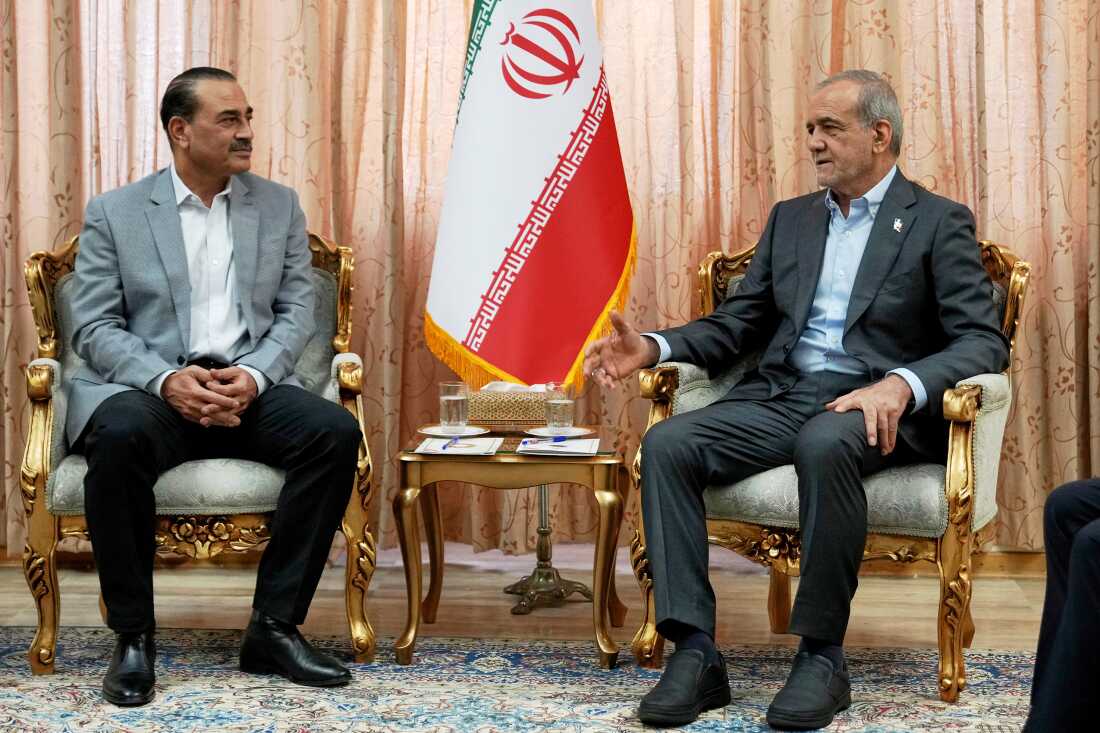
Pakistan has opened six overland corridors to Iranian trade, deployed jets to Saudi Arabia under a mutual defense pact, and mediated the ceasefire that both Washington and Tehran publicly credited to Islamabad’s army chief.
The Iran war made Pakistan into a regional power. It reinforced Russia’s strategic partnership with Tehran. It activated China’s blocking rule infrastructure that Washington will face again in any future sanctions campaign.
The scenarios being discussed in Western media, “deal or no deal,, ceasefire or resumption, miss the structural reality that neither available outcome resolves the fundamental problem.
Scenario one: A partial diplomatic framework is reached before the US midterms in November. Iran accepts enrichment constraints short of full dismantlement. Washington calls it denuclearization. Iran calls it sovereignty preserved. Both sides declare victory for their domestic audiences. The Hormuz legislative framework remains. The submarine cable governance proposal remains. The Gwadar trade corridor remains. The Pakistani and Chinese partnerships remain. Iran signs a piece of paper that restricts its enrichment timeline and receives partial sanctions relief. The strategic architecture built during the 70 days of war remains permanently in place.
Scenario two: The ground invasion phase begins. The legal architecture was cleared when Congress accepted ‘terminated.’ The Marines on USS Tripoli and USS Boxer are pre-positioned. Kharg or Abu Musa Island seizure plans are likely written. The Venezuelan model, targeted operations creating internal conditions for regime change rather than a traditional occupation, is the template being discussed. Israel struck the China-Iran Railway 10 months after it opened, establishing the doctrinal precedent that BRI infrastructure in combatant states is a legitimate target. A ground campaign would target not the Iranian military, which has survived seventy days of the most intensive American air campaign since Iraq 2003, but the political conditions inside Iran that Washington hopes will produce a different government.
Neither scenario is straightforward.
World's second-largest lithium deposit
This war was not primarily about Iran’s nuclear program.
Iran sits on the world’s second-largest lithium deposit, discovered in Hamedan province in 2023. It holds 85 million tons of newly discovered rare earth elements. Its total proven mineral reserves are valued at $770 billion. The 21st century runs on lithium and rare earths the way the 20th century ran on oil. China controls ±85% of global rare earth processing and ±60% of global lithium processing.
An Iran under American-aligned governance would represent the single largest resource acquisition in American history and would simultaneously break China’s monopoly on 21st-century critical mineral supply chains.
If Iran survives this war with its institutional architecture intact, the demonstration effect for every mineral-rich developing nation currently calculating whether to align with Washington or hedge toward Beijing is more strategically consequential than any military outcome.
Iran does not need to win this war. It needs to not lose it in a way that validates the American model of force as the instrument of resource acquisition.
AJ Jaff is a senior strategic security analyst with 20 years of experience across corporate security, military policing, and geopolitical intelligence. He covers defence, intelligence, and conflict analysis.Â
Follow him @aj_geo_analysis on X.