When Americans think of the War of 1812, they often remember the surrender of Detroit, the Battle of Lake Erie, or the defense of Fort Meigs. Few realize that one of the most important military centers in the Old Northwest was the frontier town of Urbana, Ohio.
The War of 1812 was fought between the United States, Great Britain, and Britain's Native American allies. While many of the conflict's best-known battles occurred far from central Ohio, Champaign County played a vital role in the American war effort. Urbana served as General William Hull's headquarters, a rendezvous point for Ohio militia and federal troops, and a major supply hub throughout the war.
In 1812, Urbana sat on the edge of the American frontier. At the time, Champaign County extended northward toward Lake Erie and was often referred to as “the wilderness.†Its location near important travel routes, including the historic Buffalo Trace, made Urbana a natural transportation hub for troops, supplies, government officials, and settlers moving across western Ohio.
Following the declaration of war on June 18, 1812, Ohio Governor Return Jonathan Meigs Jr. designated Urbana as a major gathering point for troops headed toward Detroit and the northwestern frontier. Soldiers, officers, supplies, and government agencies quickly converged on the town, transforming it into one of Ohio's most important military staging areas.
Among those arriving was Brigadier General William Hull, commander of the Army of the Northwest and governor of the Michigan Territory. Hull brought three Ohio militia regiments led by Colonels Duncan McArthur, Lewis Cass, and James Findlay. Their camps spread across the eastern side of town as they awaited Colonel James Miller's regiment of regular U.S. Army troops, veterans of the Battle of Tippecanoe.
Miller's arrival sparked one of the largest public celebrations in Urbana's early history. Residents erected a triumphal arch bearing the words “Tippecanoe Glory.†Citizens lined the streets while young women scattered wildflowers before the marching soldiers. Military bands played as Hull and his staff escorted the veterans through town and into camp.
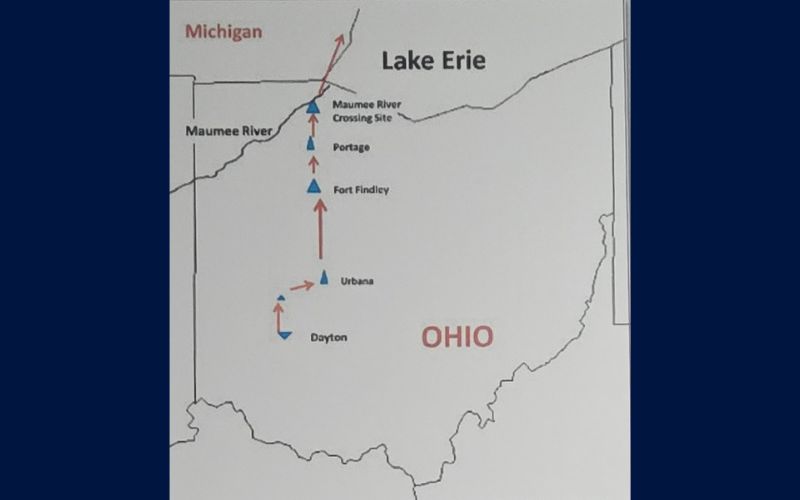
Once assembled, Hull's army departed Urbana and began cutting a military road through the wilderness toward Detroit. The route became known as Hull's Trace. Maps of the campaign traced the movement of troops from Urbana through the Ohio wilderness toward Detroit. Among the soldiers making the journey was Captain Samuel Black, whose diary provides one of the most detailed firsthand accounts of the campaign. He described exhausting marches through forests and mud, poor weather, illness, limited supplies, and the hardships faced by Ohio soldiers on the frontier.
The Detroit campaign ended in disaster. In August 1812, Hull surrendered Detroit to British forces led by Major General Isaac Brock and their Native American allies. The decision shocked the nation and led to Hull's court-martial. Modern historians note that Hull faced disrupted supply lines, the loss of Fort Mackinac, concerns about Native American attacks, and communication failures from Washington.
Even after Detroit fell, Urbana remained critical to the war effort. Additional troops poured into the area, and Kentucky Governor Isaac Shelby personally led thousands of mounted volunteers to help defend Ohio's frontier settlements. Governor Meigs again designated Urbana as a gathering point for military forces.
In May 1813, during the British siege of Fort Meigs, Urbana once again became a center of military activity. General Duncan McArthur sent runners throughout western Ohio urging men to assemble in town. Hundreds responded, including frontiersman Simon Kenton and future Ohio Governor Joseph Vance. Volunteers quickly organized and marched north before learning the siege had already been lifted.
Throughout the war, Urbana served as one of Ohio's most important military staging, recruiting, and supply centers. Quartermaster operations, recruiting stations, supply depots, hospitals, artificer shops, and pay offices all operated from the town. Troops, weapons, food, clothing, and ammunition moved through Urbana on their way to military operations across the Northwest frontier.
The town's importance was reflected in contemporary news coverage. The War, a newspaper published specifically to report on the conflict, frequently mentioned Urbana and Champaign County. Reports highlighted the community's growing role in military operations and supply efforts.
Local residents also played a key role in frontier defense. Joseph Vance organized a company of riflemen known as the Minute Men and Rangers, while other militia companies responded whenever threats emerged. Citizens contributed money, equipment, and provisions to support soldiers heading into service.
Contemporary accounts later claimed that as many as 14,000 soldiers were quartered in or passed through Urbana during the war years. While the exact number is difficult to verify, there is little doubt the military presence dramatically changed the community. The influx of soldiers boosted the local economy, increased commerce, and attracted new settlers. After the war, many veterans remained in Urbana and the surrounding countryside, helping shape the future growth of Champaign County.
Today, few visible reminders remain of the thousands of soldiers who once marched through Urbana's streets. Yet during the War of 1812, this frontier community stood at the center of Ohio's military efforts. Its strategic location, transportation connections, and ability to concentrate troops and supplies made it indispensable to the defense of the Northwest Territory.
While famous battles often dominate the history books, Urbana's story reveals how a small frontier town became one of the most important links in America's fight for the Northwest during the War of 1812.