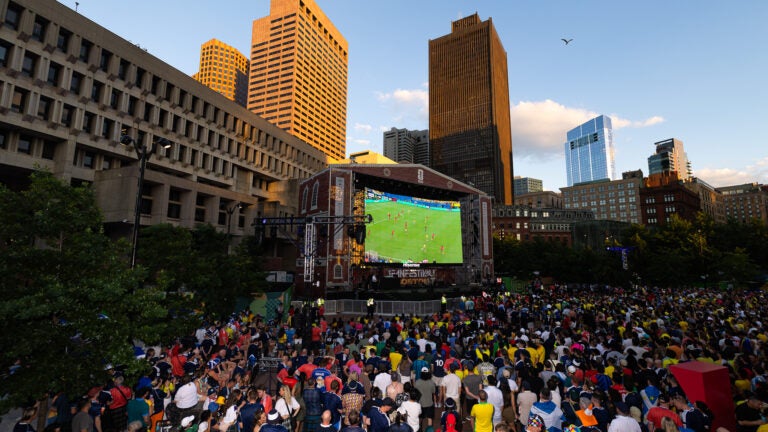
The World Cup is in full swing, in all its glory and all its absurdity.
Organizers have spent years preparing for the 39-day competition – with one painstaking requirement already resulting in amusing sights across stadiums for those paying close attention.
It is no secret FIFA requires all World Cup venues to scrub themselves of pre-existing branding to “protect its brands and the exclusive rights of its sponsors.†It is why stadiums across North America have been renamed after host cities for the duration of the tournament.
This has proven logistically challenging for some host cities, like in Atlanta, where FIFA allowed the massive Mercedes-Benz star that sits atop the NFL venue's retractable roof to remain. Removing it, organizers argued, would damage it.

There was no removing the Mercedes-Benz star in Atlanta (Robbie Jay Barratt / AMA / Getty Images)
The logistical nightmare of removing every last trace of a non-FIFA sponsor from all World Cup venues has also led to what appears to be some haphazard attempts at compliance.
Take Levi's Stadium in Santa Clara, Calif., which has been rebranded as San Francisco Bay Area Stadium – despite the stadium being 40 miles from actual San Francisco.
Before the first World Cup match there, on Saturday, fans soon noticed that the stadium's iconic front-facing Levi's logo simply had a sheet over it, doing very little to mask the jean maker's iconic batwing logo. Levi's went as far as rebranding itself on social media in that same way to poke fun at the viral mishap. The company also posted a comedic clip of the stadium's covered logo over the popular “nobody's gonna know†TikTok sound.
This was one of the most glaring examples of FIFA's stringent “clean stadiums†policy at play. The sport's governing body goes to great lengths to protect the value of its product for sponsors, with specific language in its contracts outlining the conditions that venues must be in for the World Cup.
The Athletic has previously reported on these contracts, some of which have been obtained via public records requests. In these contracts, stadiums agreed “there shall be no advertising, marketing, promotion, merchandising, licensing, signage or other commercial identification of any kind on any stands, scoreboards, seats, seatbacks, time clocks, staff uniforms, accreditation passes, fences or elsewhere inside, surrounding, or in the airspace above and around the stadium other than that which is installed by, or at the direction of, FIFA or which is approved in writing by FIFA.â€
For that reason, the brand scrubbing extends well beyond venues' facades and through every last nook and cranny of every World Cup venue.
Inside the Levi's Stadium press box, where media can enjoy meals far from the public's view, at least 23 bottles of condiments had their logos covered in black tape. Over in Boston, the usual credit card machines at Gillette Stadium were replaced with different machines instead. It's worth noting here that one of FIFA's biggest sponsors is Visa.

‘Heinz' ketchup? Not inside Levi's Stadium (The Athletic)
In Philadelphia, there was blue tape over parts of signs at the stadium formerly known as Lincoln Financial Field.

Blue tape is used to mask sponsor names in Philadelphia (The Athletic)
In New Jersey, the site of the July 19 final, organizers successfully masked nearly all MetLife Stadium references around the venue. To understand the magnitude of just how much this sponsorship is worth, the insurance company in 2011 agreed to pay between $17million and $20m (£13m-£15m) annually over a 25-year period to sponsor the venue, as previously reported by The New York Times.

‘MetLife' branding has been removed from MetLife Stadium for the World Cup (Robbie Jay Barratt – AMA/Getty Images)
But once inside the stadium, eagle-eyed fans may have noticed the “MetLife Stadium†letters are still very much visible behind the boards covering them. If you look even further, you will see the MetLife Stadium logos branding on the more than 80,000 cupholders attached to every seat inside the venue. While FIFA had asked for this specific branding to be covered up, the host committee eventually pushed back because of how much that would cost.

The ‘MetLife' branding is still visible inside the stadium (The Athletic)

Organizers pushed back against the idea of covering up the branding on cupholders (The Athletic)
Given how careful organizers have had to be to remain compliant with FIFA policies, such sightings of non-World Cup-affiliated sponsorships are likely to be few and far between.