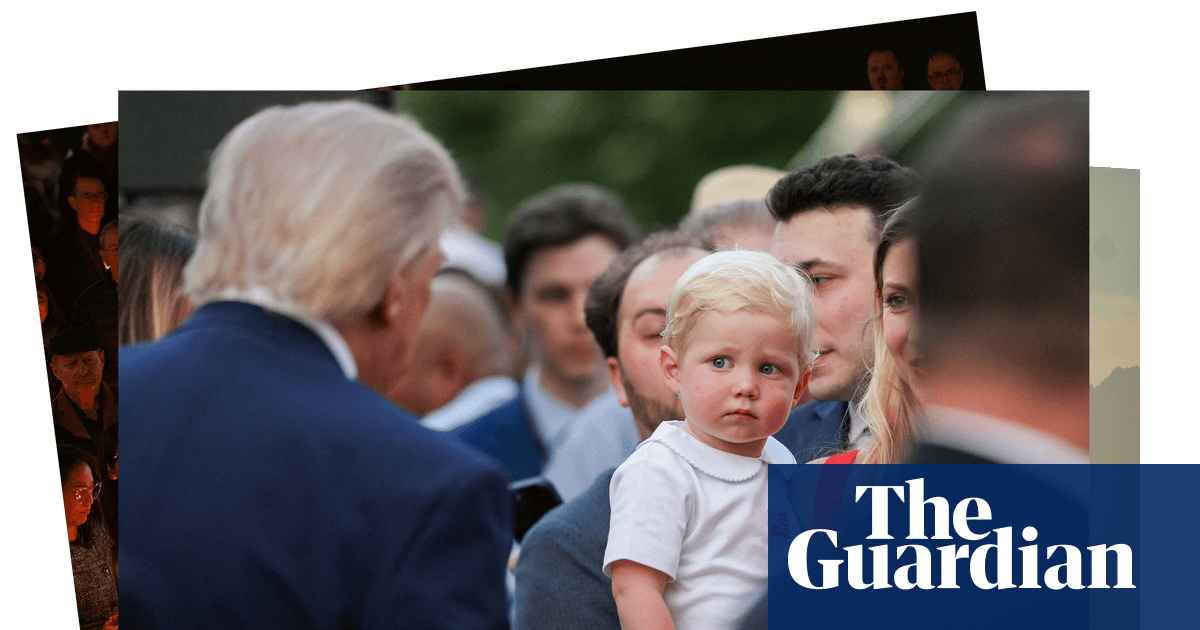
The Guardian international correspondent Lorenzo Tondo and Guardian photographer Alessio Mamo have been awarded the Ryszard Kapuściński prize, named after the legendary Polish war correspondent and author.
The annual award honours journalists and photographers who have distinguished themselves through their reporting from war zones and humanitarian crises. It is organised by the Italian Geographical Society in collaboration with Kapuściński's family.
The award ceremony will take place on 12 June in Rome at the Palazzetto Mattei during the Festival of Travel Literature. The prize will be presented by Kapuściński's daughter, Rene Maisner.
Previous recipients include the Israeli journalist and author Gideon Levy, photographer Letizia Battaglia, the Scottish writer and historian William Dalrymple, the Belgian historian and author David Van Reybrouck, the New York Times photographer Paolo Pellegrin, and the French writer and traveller Sylvain Tesson.
The prize should not be confused with the Ryszard Kapuściński award, presented each year in Warsaw to the best books and works of reportage translated into Polish.
Tondo, 44, joined the Guardian in 2016 and has reported extensively from Ukraine, the Middle East and the migration routes across the Mediterranean.
According to the jury's statement, which awarded Tondo the prize for journalistic writing, he was recognised “for the rigour of his reporting and the narrative depth with which he has chronicled some of the most significant crises of our time; for conveying both the facts of everyday life and the complexity of the present, without forgetting the human stories within major geopolitical events, with understanding and empathy, putting oneself in the place of others (as KapuÅ›ciÅ„ski taught). As a correspondent and war reporter for the Guardian, he has covered conflicts across the Middle East, the war in Ukraine and the Israeli-Palestinian conflict, while also producing in-depth work such his latest book Trame di guerra (Threads of War), published by Mondadori.â€
Mamo, 49, is a freelance photographer and film-maker based in Sicily and the Middle East. A regular contributor to the Guardian, he has received the World Press Photo award and an Amnesty International media award.
The jury recognised Mamo's “ability to use photography as a contemporary tool of reporting and rigorous witness, documenting with precision the stories before his lens, from the frontlines of war to global humanitarian emergencies, both for humanitarian organisations and major international news outletsâ€.
“More than writers, it is journalists and photographers who continue to travel and to push the boundaries of expression, offering deeper and more meaningful accounts of the world than the undifferentiated stream of information in which we are constantly immersed,†said Antonio Politano, artistic director of the Festival of Travel Literature. “And we were struck by Tondo's articles and Mamo's photographs. KapuÅ›ciÅ„ski once said that “the most valuable journey is that of reportage: the ethnographic or anthropological journey undertaken to better understand the world, history and the changes that have taken place, so that the knowledge acquired can be passed on to others.â€
Tondo and Mamo have worked closely together since 2017, covering wars and humanitarian emergencies for the Guardian.
In 2018, they travelled through the Balkans to investigate allegations that migrants were subjected to brutal beatings by Croatian officials along the border with Bosnia. Their reporting included the first video evidence documenting abuses against asylum seekers.
In 2022, the pair travelled to Ukraine, where they spent more than two years reporting on the conflict. Their work documented the massacre of Ukrainian civilians by Russian forces, the use of banned weapons and evidence of war crimes committed by the Kremlin.
In 2023, after the earthquake that killed tens of thousands of people in Turkey and Syria, Tondo and Mamo gained access to the rebel-held province of Idlib to document the devastation inflicted on a population already ravaged by war and poverty.
Last summer, they flew over Gaza aboard a Jordanian military aircraft, capturing images of neighbourhoods reduced to rubble during Israel's bombardment of the territory.
Ryszard Kapuściński was a Polish journalist, photographer and author who served as the communist-era Polish Press Agency's only correspondent in Africa during the continent's decolonisation. He also reported from South America and Asia.
His most celebrated works include Another Day of Life, about Angola, and The Emperor, an account of the downfall of Ethiopian ruler Haile Selassie that has also been read as a veiled satire of communist Poland. Kapuściński remains the most widely-translated Polish author in the world.